
How to Follow Up with Real Estate Leads Without Chasing, Begging, or Forgetting
Follow-Up Is Where Deals Go to Die
You generated 80 leads last month. You called most of them. Some picked up. Some didn't. You left voicemails. You sent a few texts. You told yourself you'd try again tomorrow.
Tomorrow came. You had new leads. The old ones slid down the list. By Friday, those Monday leads were buried. By the following Monday, they were forgotten.
End of the month, you closed 2 deals. Your marketing generated enough leads for 5. The gap between 2 and 5 isn't bad leads. It isn't a tough market. It's follow-up that never happened.
How to follow up with real estate leads is the most important question in your business—and the one most investors answer with "I'll get to it later." Later is where deals die.
Why Most Follow-Up Fails
The problem isn't that investors don't know follow-up matters. Everyone knows. The problem is that follow-up competes with everything else in your day—and it always loses.
It loses to new leads. A fresh lead feels more exciting than a callback to someone who didn't pick up yesterday. So you chase the new one and let the old one age. This is human nature, and it kills your pipeline.
It loses to appointments. You're driving to a meeting at 1 PM. Three leads need follow-up calls. You'll do them after the appointment. The appointment runs long. You get back to your desk at 4:30. You make one call. The other two slide to tomorrow.
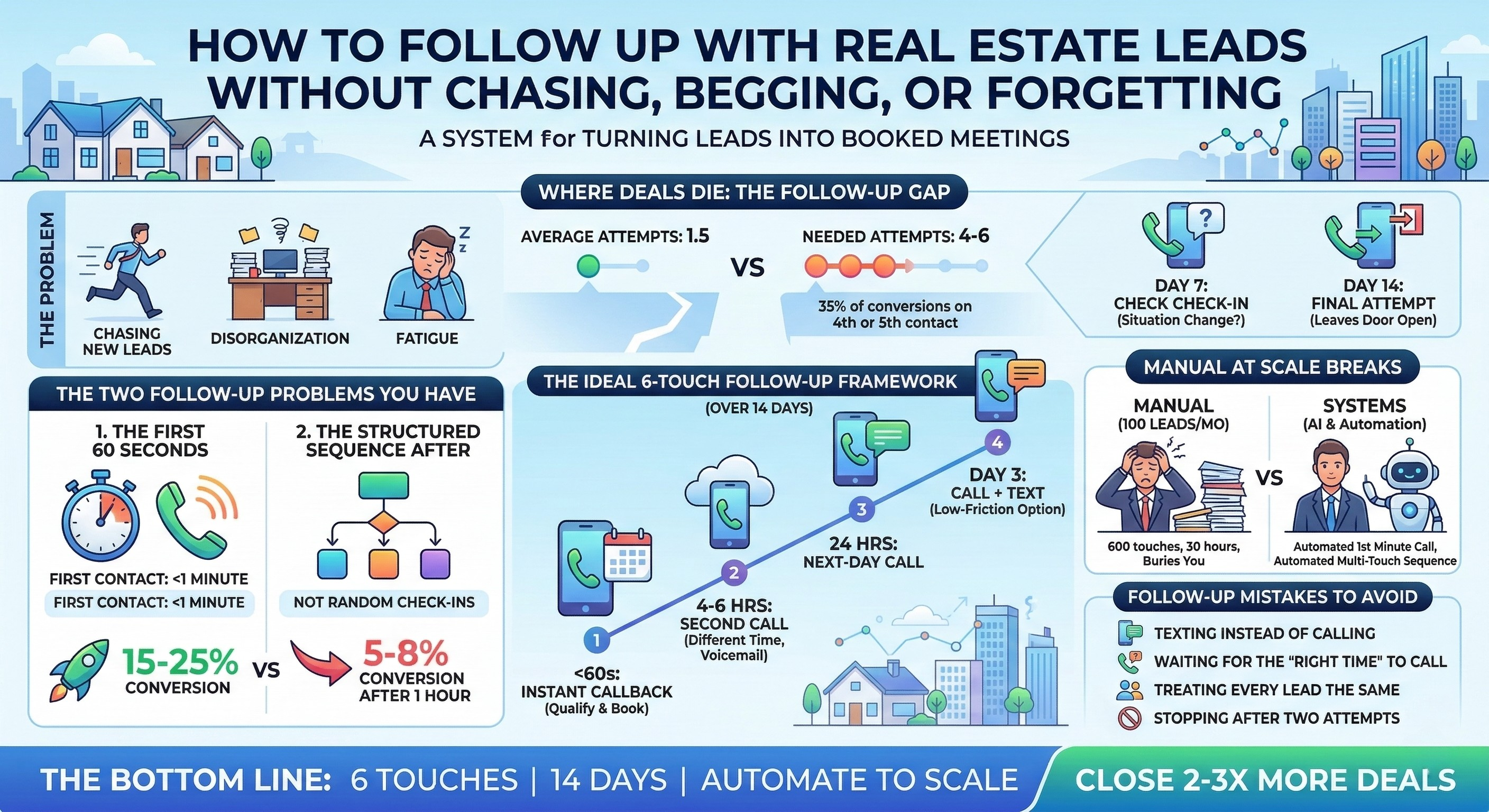
It loses to fatigue. Calling someone for the third time who hasn't picked up feels pointless. Your brain tells you they're not interested. But the data tells a different story—35% of real estate leads who eventually convert don't respond until the 4th or 5th contact attempt. You're quitting right before the payoff.
It loses to disorganization. Which leads need a second call? Which ones need a third? Who said to call back next Tuesday? If this information lives in your head or scattered across CRM tags you never check, follow-up doesn't happen.
The result: most real estate investors make 1.5 follow-up attempts per lead. The leads that convert typically require 4-6 touches. You're doing a third of the work and wondering why you're getting a third of the results.
The Two Follow-Up Problems You Actually Have
When investors ask how to follow up with real estate leads, they're usually thinking about one problem. They actually have two.
Problem 1: The first 60 seconds. This isn't really follow-up. It's first contact. But most investors lump it together because they treat every callback the same—whenever they get around to it. The first contact after a lead submits needs to happen in under 60 seconds. Leads contacted in the first minute convert to appointments at 15-25%. Wait an hour and you're at 5-8%. Wait until tomorrow and you're cold-calling.
Problem 2: The sequence after. The lead who doesn't pick up the first call. The lead who says "call me next week." The lead who seemed interested but didn't commit. These leads need a structured sequence—not a random check-in whenever you remember. They need the right number of touches, at the right intervals, with the right message each time.
Most investors solve neither problem. The ambitious ones try to solve both manually. That works until you're generating more than 30 leads a month, at which point the volume buries you.
What Good Follow-Up Actually Looks Like
Forget the tactics for a moment. Here's the framework for how to follow up with real estate leads in a way that actually books meetings:
Touch 1: Instant callback (under 60 seconds). Lead submits. Phone rings. Live conversation—not a text, not a voicemail drop. The goal is a qualified appointment. If the seller picks up, you qualify and book. If they don't, you move to touch 2.
Touch 2: Second call (4-6 hours later). Different time of day. The seller who didn't pick up at 10 AM might answer at 3 PM. Short voicemail if no answer: "Calling about the property you submitted on earlier today. I'll try you again tomorrow."
Touch 3: Next-day call (24 hours after submission). Third attempt. By now, you've called at two different times. If they answer, the conversation picks up naturally—you reference the form they filled out and the previous attempts.
Touch 4: Day 3 call + text. First text message enters the sequence. "Hi [name], I've been trying to reach you about [property address]. Still interested in discussing options? I have time this week." Text gives the seller a low-friction way to respond if they've been screening calls.
Touch 5: Day 7 check-in. One week after submission. "Just following up on the property you inquired about. If your situation has changed, no worries. If you'd still like to talk, I have availability this week."
Touch 6: Day 14 final attempt. Two weeks out. "Last follow-up on [property address]. If you'd like to revisit this down the road, you have my number." This closes the active sequence but leaves the door open.
Six touches over 14 days. That's the structure. The problem is executing it consistently across 50, 80, or 150 leads a month.
You Can't Follow Up Manually at Scale
Here's the math that breaks manual follow-up:
Say you generate 100 leads a month. Each lead needs 6 follow-up touches over 14 days. That's 600 follow-up actions per month—phone calls, texts, voicemails. If each action takes 3 minutes, that's 1,800 minutes. Thirty hours of follow-up per month. Just on follow-up.
That's not counting new lead callbacks, appointment prep, driving to meetings, negotiating deals, managing closings, or anything else you do in a day. Thirty hours of repetitive phone work on top of running your business.
At 50 leads a month, it's 15 hours. Tight but possible. At 100, it's a full-time job layered on top of your actual full-time job. At 150, it's physically impossible without help.
This is why the answer to how to follow up with real estate leads always comes back to systems. Not because systems are trendy. Because the math doesn't work any other way.
The System That Replaces Manual Follow-Up
The operators who consistently book 20-30 appointments a month from their leads aren't working harder than you. They built a system that handles the two follow-up problems automatically.
For the first 60 seconds: An AI caller that dials every new lead within 60 seconds of submission. No queue. No delay. The lead's phone rings while they're still looking at the confirmation page. The AI qualifies the lead and books the appointment—or tags it for the follow-up sequence.
For the sequence after: Automated multi-touch follow-up that runs without you. Second call at the right interval. Third call at a different time of day. Text on day 3. Check-in on day 7. Final touch on day 14. Every lead gets the full sequence regardless of whether you're busy, tired, or on vacation.
An investor in San Diego was generating 110 leads a month and following up manually. He tracked his actual follow-up activity for 30 days. Average touches per lead: 1.8. He was making one call, maybe a second, and moving on. Leads were falling out of his pipeline at every stage.
He moved first-call responsibility to Elevista and set up the automated follow-up sequence. First month: average touches per lead went from 1.8 to 5.4. Appointments booked went from 11 to 27. He closed 7 deals instead of his usual 3. His marketing didn't change. His follow-up did.
The leads were always there. He was just quitting on them too early.
For the full picture on what those unworked leads cost over time, see The True Cost of Missed Real Estate Leads.
Follow-Up Mistakes That Kill Your Pipeline
Knowing how to follow up with real estate leads also means knowing what not to do:
Texting instead of calling. A text is not a follow-up. It's a suggestion that the seller do the work of calling you back. Motivated sellers filled out a form because they want someone to call them. Texts are supplemental—touch 4 or 5 in the sequence, not touch 1.
Waiting for the "right time" to call. There is no right time. The right time was 60 seconds after submission. Stop timing your calls. Start making them.
Treating every lead the same. A seller who said "call me Thursday" needs a Thursday call. A seller who mentioned foreclosure needs urgency. A seller who's six months out needs a longer drip. One-size follow-up wastes your time on leads that aren't ready and neglects the ones that are.
Stopping after two attempts. The data is clear. Most conversions happen between touch 4 and touch 6. If you're giving up after 2 attempts, you're quitting before the game starts.
The Bottom Line
How to follow up with real estate leads isn't a mystery. It's a math problem. Six touches over 14 days. Every lead. Every time. No exceptions.
The investors who do this consistently close 2-3x more deals than the ones who wing it. Not because they're better negotiators. Because they're still in the conversation when the seller is ready to move.
You can do it manually at 30 leads a month. You can't at 100. And the difference between "I'll get to it" and a system that runs automatically is the difference between 2 deals a month and 7.
Stop following up when you remember. Start following up every time.
Try Elevista free and automate your follow-up from the first 60 seconds →
Know investors who generate good leads but never follow up? Join the Elevista Partner Program and earn recurring commissions every time you refer someone who's ready to stop leaving deals on the table.
Get insights delivered weekly
Join real estate investors who get speed-to-lead strategies and product updates every week.