
Real Estate Investor Time Management: Stop Doing the $15/Hour Work
You're Busy. You're Not Productive.
You worked 11 hours yesterday. Made 30 calls. Drove to two appointments. Answered emails. Updated your CRM. Chased a title company. Texted a contractor. Responded to three new leads—eventually.
At the end of the day, you felt exhausted. You also felt like you didn't move the needle. Because you didn't. Most of what filled your day was activity, not progress. Motion, not money.
Real estate investor time management isn't about squeezing more into your schedule. It's about recognizing that most of what's on your schedule shouldn't be there in the first place.
The $15/Hour Trap
Every task in your business has a dollar value. Some tasks are worth $500 an hour. Some are worth $15. The problem is that most investors spend 60-70% of their day on the $15 tasks and wonder why they can't scale past $30,000 a month.
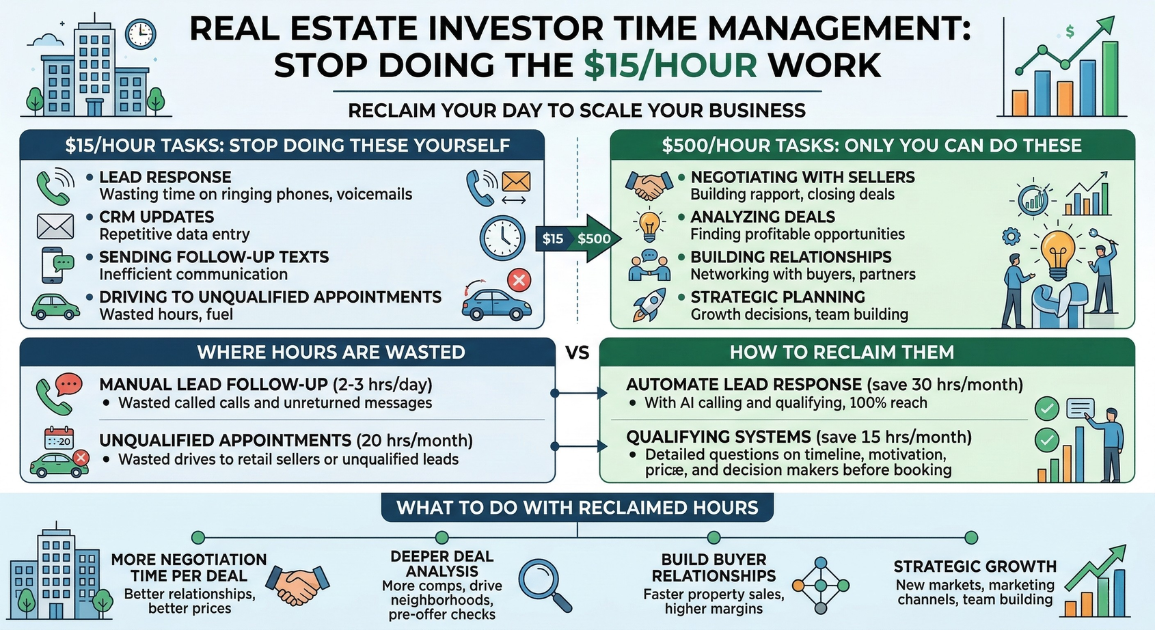
$500/hour tasks: Negotiating with sellers at the kitchen table. Analyzing deals. Building relationships with buyers. Strategic planning. Making decisions that directly produce revenue. These are the tasks only you can do.
$50/hour tasks: Reviewing comps. Managing contractors. Coordinating closings. Important work, but work that someone else could handle with training and clear instructions.
$15/hour tasks: Returning lead calls. Leaving voicemails. Sending follow-up texts. Updating CRM records. Scheduling appointments. Driving to meetings with unqualified sellers. Administrative work that keeps the machine running but doesn't close deals.
Here's the math that should bother you. If you work 10 hours a day and spend 6 of those hours on $15/hour tasks, you're earning $90 worth of value in those 6 hours. If you spent those same 6 hours on $500/hour tasks, you'd produce $3,000 in value. Same hours. Different allocation. Wildly different outcome.
Real estate investor time management starts with one question: what did I do today that only I could do? If the honest answer is "not much," the problem isn't your work ethic. It's your task list.
Where Your Hours Actually Go
Most investors have never audited their time. They think they know where it goes. They're wrong.
Track your day for one week. Every 30 minutes, write down what you're doing. At the end of the week, categorize every entry into three buckets: revenue-producing, revenue-supporting, and neither.
Here's what most investors find:
Lead response and follow-up: 2-3 hours/day. Calling new leads back. Calling old leads again. Leaving voicemails nobody returns. Texting sellers who don't respond. This is the single biggest time drain in most operations—and the one with the clearest solution.
Driving: 1-2 hours/day. Driving to appointments, driving to properties, driving to closings. Some of this is unavoidable. But how many of those drives were to appointments that turned out to be unqualified? Every wasted drive is 2-3 hours gone—the drive, the meeting, the drive back.
Administrative work: 1-2 hours/day. CRM updates, email, contractor coordination, title company follow-up. Necessary but not revenue-producing. And most of it could be handled by a $20/hour virtual assistant.
Actual deal work: 2-3 hours/day. Negotiating, analyzing, closing. The work that actually makes you money. Two to three hours out of a 10-hour day. That's 20-30% of your time on the only work that matters.
The investors who scale past $50,000 a month don't work more hours. They flip that ratio. They spend 60-70% of their time on deal work and 20-30% on everything else.
The First Hour You Should Reclaim
If you're going to fix your real estate investor time management, start with the biggest time sink: lead response.
The average solo investor spends 2-3 hours a day calling leads. That includes new lead callbacks, follow-up calls, voicemails, and texts. At 100 leads a month, with 6 follow-up touches per lead, that's 600 actions. At 3 minutes each, that's 30 hours a month—just on the phone.
And here's the part that stings: most of those calls don't connect. You dial. It rings. Voicemail. You leave a message. The actual conversation rate on outbound follow-up calls is 15-20%. That means 80% of your phone time produces nothing. You're spending 24 hours a month listening to ringing and recording voicemails.
This is why lead response is the first thing smart investors automate. Not because it's unimportant—it's critical. Because it's high-volume, repetitive, and time-sensitive in a way that humans can't consistently deliver.
An AI system that calls every lead in under 60 seconds and runs the full follow-up sequence doesn't just save you 30 hours a month. It performs better than you did in those 30 hours. It calls faster. It never misses a lead. It follows up on schedule every single time. And it frees you to spend those 30 hours on the $500/hour work.
An investor in Columbus was working 12-hour days and closing 3 deals a month. He tracked his time for two weeks. Lead calling and follow-up: 3.2 hours per day. Driving to unqualified appointments: 1.5 hours per day. Actual negotiation and deal analysis: 2.1 hours per day. The rest was admin.
He moved lead response and follow-up to Elevista. That reclaimed 3 hours a day immediately. But the second-order effect was bigger: because Elevista qualified leads before booking appointments, he stopped driving to unqualified meetings. That saved another hour a day. He reinvested those 4 hours into deal work—more comps, better negotiations, stronger buyer relationships.
Three months later, he was closing 6 deals a month. Working 9 hours instead of 12. His revenue doubled while his hours dropped. That's not a productivity hack. That's what happens when you stop doing $15/hour work yourself.
The Unqualified Appointment Tax
Here's a time cost most investors don't calculate: driving to meetings that were never going to close.
If you're setting your own appointments—calling a lead, having a brief conversation, and booking a meeting—you're probably running a 40-50% qualification rate. That means half your appointments are with sellers who want full retail, aren't ready to sell, have unrealistic timelines, or thought you were a realtor.
Each wasted appointment costs you 2-3 hours. The drive there, the meeting, the drive back. If you run 15 appointments a month and half are unqualified, that's 7-8 wasted appointments. At 2.5 hours each, that's 20 hours a month sitting across from people who were never going to do a deal with you.
Twenty hours. That's half a work week. Gone.
The fix isn't fewer appointments. It's better-qualified appointments. When the first conversation includes real qualifying questions—property address, mortgage balance, timeline, motivation, decision makers, price expectations—the sellers who make it onto your calendar are the ones worth driving to.
Elevista qualifies before booking. The questions aren't surface-level. They dig into the details that determine whether a meeting is worth your time. Investors using the system report 85-90% qualification rates on booked appointments, compared to 40-50% when they set appointments themselves. That means instead of 7-8 wasted drives a month, you're looking at 1-2. You just got 15 hours back.
For more on how to cut unqualified appointments at the source, see How to Qualify Motivated Sellers.
What to Do With the Hours You Get Back
Reclaiming time only matters if you reinvest it in the right work:
More negotiation time per deal. Instead of rushing through appointments because you have three more today, spend the time. Sit at the kitchen table longer. Listen more. Build the relationship. Deals get better when you're not watching the clock.
Deeper deal analysis. Run more comps. Drive the neighborhood. Talk to contractors before you make an offer, not after. The investors who consistently buy at the best basis aren't smarter—they spend more time on each deal because they have time to spend.
Buyer relationship building. Your disposition list is your second business. The investors who cultivate their buyer network—regular check-ins, first-look deals, relationship maintenance—move properties faster and at better margins. This work only happens when you have margin in your schedule.
Strategic growth. New marketing channels, new markets, team building, systems development. The work that takes you from 5 deals a month to 10. This work never happens when you're buried in lead calls and driving to unqualified appointments.
The Bottom Line
Real estate investor time management isn't about working harder or waking up earlier. It's about recognizing that 60% of your day is spent on work that doesn't require your skills, your judgment, or your presence.
The phone calls. The follow-up sequences. The voicemails. The unqualified appointments. This work needs to happen—but it doesn't need to happen because of you.
Every hour you spend on $15/hour work is an hour you're not spending on a $500/hour task. At 4-6 reclaimed hours per day, that's the difference between 3 deals a month and 6. Between $30,000 and $60,000. Between grinding and growing.
Stop doing work the system can do better. Start doing the work only you can do.
Try Elevista free and reclaim the hours you're wasting on lead calls →
Know investors who work 12-hour days and still can't scale? Join the Elevista Partner Program and earn recurring commissions every time you refer someone who's ready to stop trading time for tasks a system handles better.
Get insights delivered weekly
Join real estate investors who get speed-to-lead strategies and product updates every week.