How to Scale a Wholesaling Business Past 10 Deals/Month

Why Do Most Wholesalers Hit a Ceiling?
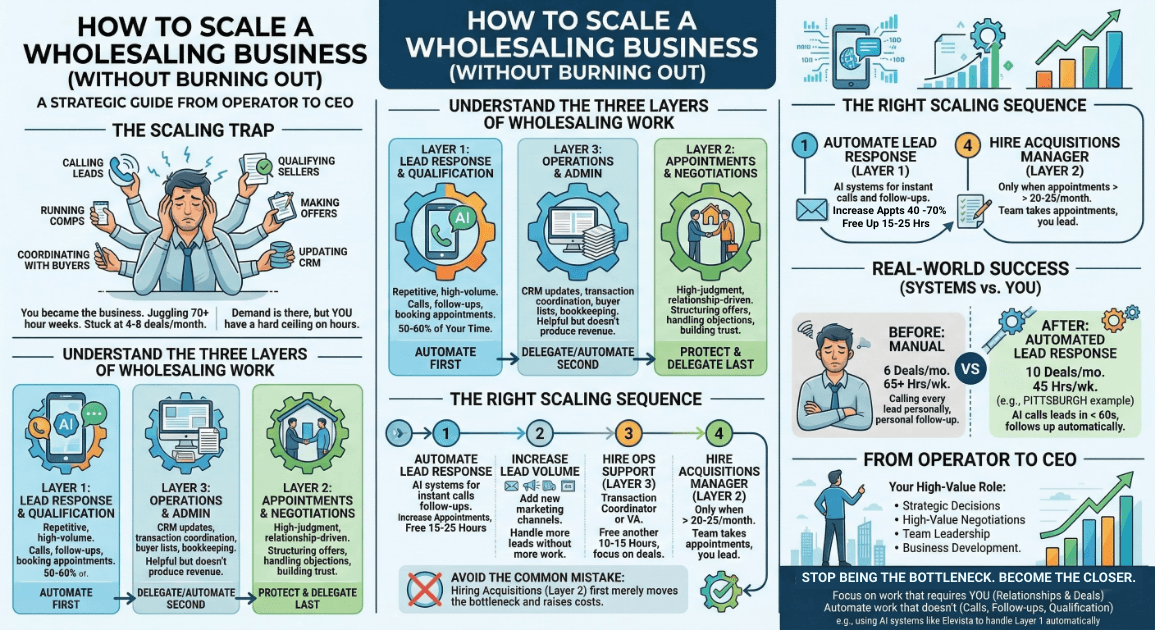
You started wholesaling to build a business. Somewhere along the way, you became the business. You're the one calling leads, qualifying sellers, booking appointments, running comps, making offers, coordinating with buyers, chasing title companies, managing the marketing, and updating the CRM.
The Solo Operator Trap
You're doing 6 deals a month. You're working 70 hours a week. And you've hit a wall. Not because the market ran out of deals, but because you ran out of hours.
That's the scaling trap every wholesaler hits. The business doesn't stop growing because demand dried up. It stops growing because the person at the center of every transaction can't do transaction number seven without dropping transaction number four.
What Scaling Really Means
Learning how to scale a wholesaling business isn't about doing more. It's about removing yourself from the work that doesn't require you, so the work that does gets your full attention.
Why Do Most Wholesalers Stall at 4-8 Deals a Month?
The solo wholesaler model has a hard ceiling. Here's the math.
The Hours Don't Add Up
At 100 leads a month, you need to make 100 first calls, run 400-600 follow-up touches, book 15-20 appointments, drive to each one, analyze each deal, make offers, negotiate, and close. That's roughly 200 hours of work. There are 160 working hours in a month if you take weekends off. You're already over capacity before you count marketing, bookkeeping, buyer management, or eating lunch.
Working Harder Doesn't Work
Most wholesalers solve this by working more hours. Six AM to midnight. Saturdays and Sundays. That gets you from 4 deals to 6, maybe 8. But the quality drops. You're tired. You miss follow-ups. You show up to appointments underprepared. Your conversion rate falls even as your volume rises. You're running harder to stay in the same place.
What the Top Performers Do Differently
The wholesalers who break through 10, 15, 20 deals a month didn't find a way to work 300 hours. They found a way to remove 100 hours of work from their plate without losing the output.
What Are the Three Layers of Scaling a Wholesaling Business?
Every wholesaling operation has three layers of work. Scaling means automating or delegating the right ones in the right order.
Layer 1: Lead Response and Qualification
This is the high-volume, time-sensitive, repetitive work. Calling leads back. Qualifying them. Following up on non-connects. Booking appointments. Experienced wholesalers report it accounts for roughly half or more of their total hours, and it's the first thing that should leave your plate, because speed and consistency matter more than personality at this stage.
Layer 2: Appointments and Negotiations
This is the high-judgment, relationship-driven work. Sitting with sellers. Reading the room. Structuring offers. Handling objections. Building trust. This is where your skills actually matter. This is the last thing that should leave your plate.
Layer 3: Operations and Admin
CRM updates, transaction coordination, buyer list management, marketing oversight, bookkeeping. This work keeps the machine running but doesn't directly produce revenue. It should leave your plate second, after Layer 1, before Layer 2.
Most wholesalers trying to scale make the same mistake: they hire for Layer 3 first. They get a transaction coordinator or a virtual assistant to handle paperwork. That frees up 10-15 hours a month. Helpful, but it doesn't move the needle because the bottleneck was never paperwork. The bottleneck was the 100 hours a month spent on calls, follow-ups, and qualification.
Why Should You Remove the Biggest Bottleneck First?
Layer 1, lead response and qualification, is where scaling starts. It's the most hours, the most repetitive work, and the area where a system outperforms a human solo operator.
What Automated Lead Response Looks Like
A lead fills out your form. In under 60 seconds, the system calls them. A conversation happens: property details, timeline, mortgage, motivation, decision makers. If the lead qualifies, an appointment hits your calendar with full notes. If they don't answer, a follow-up sequence runs automatically over 14 days. Six touches. Phone and text. Every lead. No exceptions.
You didn't make a single call. You didn't log into your CRM. You didn't set a reminder. You opened your calendar and drove to a qualified appointment with a seller who's ready to talk.
Real Results from Removing Layer 1
A wholesaler in Pittsburgh was doing everything himself at 6 deals a month. Working 65-hour weeks. Calling every lead personally, running follow-ups from a spreadsheet, booking his own appointments. He moved Layer 1 to an AI calling system. First month, his appointments went from 14 to 23, because every lead was getting called in under 60 seconds and followed up on consistently, including nights and weekends. His deals went from 6 to 10. His work hours dropped from 65 to 45. He didn't hire anyone. He removed himself from the work that didn't need him.
Month three, he hired a dispositions manager to handle buyer coordination (Layer 3). Deals held at 10-11 per month. Hours dropped to 35. He was spending his time exclusively on appointments and negotiations, the only work that required his judgment and relationships.
What Is the Hiring Mistake That Kills Scaling?
When wholesalers think about how to scale a wholesaling business, their first instinct is to hire. Get an acquisitions manager. Train them on the phones. Let them run appointments.
Hiring for the Wrong Layer First
Here's the problem: you're hiring for Layer 2 before you've solved Layer 1. That acquisitions manager still needs leads called back instantly. They still need consistent follow-up on non-connects. They still need qualified appointments on their calendar. If your lead response system is still manual, you've just moved the bottleneck from you to them, and now you're paying $4,000-$6,000 a month for someone to hit the same ceiling you did.
The order matters. Automate Layer 1 first. Then hire for Layer 3 operations. Then, and only then, hire for Layer 2 when your appointment volume exceeds what one person can handle.
The Cost of Getting the Order Wrong
A wholesaler in Raleigh hired an acquisitions manager at $5,000/month as his first scaling move. The acquisitions manager was good on the phone. But he was only connecting with 30% of leads because callbacks were taking 2-4 hours. He was booking 12 appointments a month and closing 3 deals. The wholesaler was paying $5,000/month for 3 incremental deals, $1,667 per deal just in labor cost before marketing spend.
He added an AI system to handle instant callbacks and follow-up. The acquisitions manager stopped cold-calling and started showing up to pre-qualified appointments. His appointments went from 12 to 22. Deals went from 3 to 7. Same hire. Same salary. Different system feeding the pipeline. The cost per incremental deal dropped from $1,667 to $714.
The system made the person more productive. The person didn't make the system unnecessary.
What Does a 20+ Deal Per Month Operation Actually Look Like?
Scaling to 20 deals a month isn't 4x the work of 5 deals a month. It's a different operating model entirely.
The Infrastructure Required
Lead flow: 300-500 leads per month across multiple channels. Direct mail, PPC, SEO, cold calling lists, referrals. You can't get to 20 deals on one lead source. Successful wholesalers typically use three or more lead sources simultaneously.
Lead response: Fully automated. Every lead called in under 60 seconds. Every non-connect followed up automatically. You're not touching leads until they're sitting across from you at the kitchen table.
Appointments: 40-60 per month. At this volume, you need at least two people running appointments: you and an acquisitions manager. Or you handle the highest-value appointments and the acquisitions manager handles the rest.
The Team and Your Role
Operations: Transaction coordinator handling paperwork, title coordination, and closing timelines. Dispositions manager handling buyer outreach and assignment coordination. Virtual assistant handling CRM maintenance and marketing logistics.
Your role: Strategic decisions, high-value negotiations, team leadership, and business development. You're the CEO, not the call center.
The math only works if Layer 1 is fully automated. At 400 leads a month with 6 follow-up touches each, that's 2,400 phone actions. No person or team of people can do that consistently at the speed required. A system can.
What Is the Right Scaling Sequence for Wholesalers?
If you're at 3-6 deals a month and want to get to 10-15, here's the sequence that works.
Step 1: Automate Lead Response
Move every first callback and follow-up sequence to a system. Research from the Harvard Business Review found that responding within five minutes makes you 21x more likely to qualify a lead than waiting 30 minutes. Wholesalers who make this change commonly report significant increases in booked appointments and reclaim 15-25 hours a month. Do this before anything else.
Step 2: Increase Lead Volume
With automated response, you can handle more leads without more hours. Add a second marketing channel. The system absorbs the additional volume.
Step 3: Hire Operations Support
Transaction coordinator or virtual assistant for Layer 3 work. This frees another 10-15 hours a month and lets you focus entirely on appointments and deal-making.
Step 4: Hire an Acquisitions Manager
Only when your appointment volume exceeds 20-25 per month and you're consistently closing at a rate that justifies the salary. The acquisitions manager walks into a system that's already running: qualified appointments, organized pipeline, operational support.
Skipping steps costs money. Hiring before automating means your hires are doing work a system should handle. Increasing lead volume before automating means more leads die in your CRM. The sequence protects your cash and your sanity.
For the time management framework that sits underneath all of this, Real Estate Investor Time Management breaks down exactly which hours to protect and which to hand off first.
Frequently Asked Questions
How many deals can a solo wholesaler realistically handle per month?
Most solo wholesalers stall at 4-8 deals per month. The math is simple: 100 leads require roughly 200 hours of calling, follow-up, appointments, analysis, and admin. With only 160 working hours in a month, you're over capacity before you factor in marketing or personal time.
What should I automate first in my wholesaling business?
Automate lead response and qualification first. For most solo wholesalers, it represents the largest share of total work hours and it's where speed matters most. A system that calls every lead within 60 seconds and runs consistent follow-up sequences will have a bigger impact than any other single change.
Is it better to hire or automate when scaling?
Automate before you hire. A human hire without an automated lead response system will hit the same ceiling you did. Automation makes your future hires dramatically more productive by feeding them pre-qualified appointments instead of raw leads.
How much does it cost per deal when you scale the wrong way?
In one example, a wholesaler paying $5,000/month for an acquisitions manager without automated lead response was spending $1,667 per incremental deal. After adding automated callbacks, the same hire produced more than double the deals, dropping the cost to $714 per deal.
What lead volume do I need for 20 deals per month?
Industry experience suggests you'll need 300-500 leads per month across multiple marketing channels. At that volume, fully automated lead response is a requirement since 2,400+ phone actions per month is beyond what any team can handle manually with the speed required.
What Is the Bottom Line on Scaling a Wholesaling Business?
Learning how to scale a wholesaling business comes down to one question: what work requires you, and what work just requires a system?
Calling leads back in 60 seconds doesn't require you. Following up six times over 14 days doesn't require you. Qualifying a seller on property details, timeline, and mortgage doesn't require you. Booking an appointment on your calendar doesn't require you.
Sitting across from a motivated seller, reading the room, structuring the right offer, and closing the deal. That requires you.
Elevista handles everything that doesn't. Every lead called in under 60 seconds. Every non-connect followed up automatically. Every qualified seller booked on your calendar with full details. You show up to appointments. You close deals. You scale.
Stop being the bottleneck. Start being the closer.
Try Elevista free and remove yourself from the lead response bottleneck →
Know wholesalers who want to scale but can't stop answering the phone? Join the Elevista Partner Program and earn recurring commissions every time you refer someone who's ready to build a business instead of run a one-person show.
Frequently Asked Questions
What is the biggest bottleneck when scaling a wholesaling business?
Should I hire an acquisitions manager or automate lead response first?
How many deals per month can a solo wholesaler realistically close?
What does a 20-deal-per-month wholesaling operation look like?
What is the right order for scaling a wholesaling business?
Get insights delivered weekly
Join real estate investors who get speed-to-lead strategies and product updates every week.