
The 5 AI Tools I Use to Run a Real Estate Portfolio (And What Each One Is For)
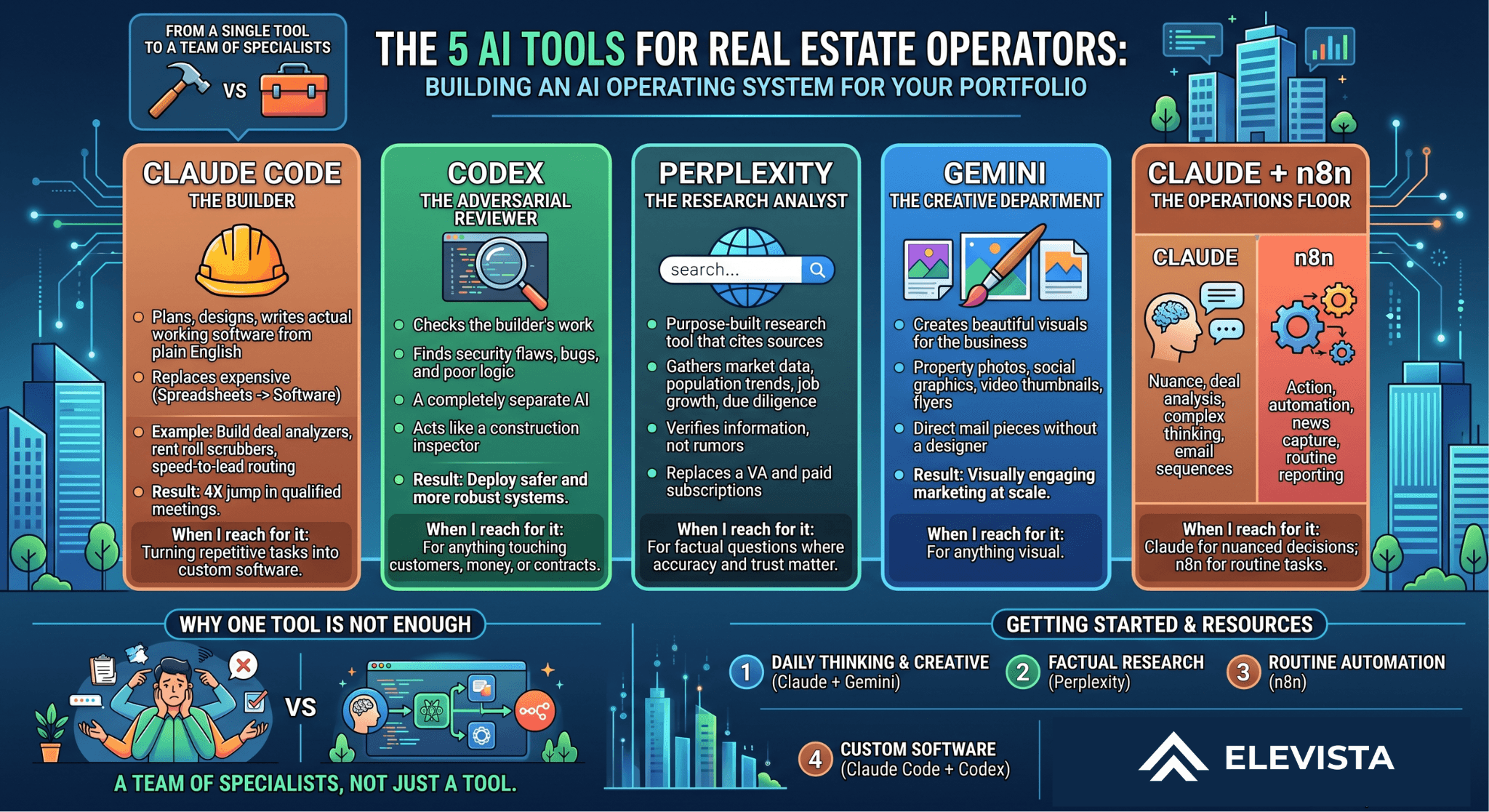
Most investors think AI means ChatGPT.
That's like saying "construction" means a hammer. A hammer is great. You need one, for sure. But you're not framing a house with just a hammer.
At Clark St Capital and Clark St Homes, we don't use AI. We run the companies on an AI operating system. Five tools. Each one has a specific job. Each one is the best in the world at that job. Together, they let me run a real estate portfolio with a lean team and ship software products through the team at Elevista.
These are tools you can use today. You don't need to be technical. You just need to be clear on how you want things to work. Then you need a critical eye to it and iterate until it works the way you want it to work.
Here's the stack. Plain English. No hype.
Claude Code: The Builder
If you've ever said "there should be a tool for this," Claude Code is the tool that builds the tool.
We use Claude Code to plan, design, write and run software. Not drafts. Not outlines. Actual working code. I describe what I need in plain English. Then Claude Code builds it, tests it, and fixes it when it breaks. Over time (I've been doing this for a couple of years now) you'll build a keen eye for what to look for and how to avoid gotchas.
We use Claude Code to build our own internal systems at the Clark St companies. Deal analyzers. Rent roll scrubbers. Lead routing logic. Things I used to pay developers $150 an hour to build in weeks now take a weekend to build, test and deploy. I used Claude Code to solve our speed-to-lead problem. Motivated sellers would hit our website form and the lead would sit for hours. In some cases, days. Now, those motivated sellers get a phone call back from our real estate AI agent (we call her Katie) in about 35 seconds, and my qualified meetings have jumped 4X. Our lead generation is killing it in a really tight inventory market here in Connecticut.
The wild part? I'm not a developer. Never have been. But I can describe how a deal analysis process should work along with the outputs I need to make a business decision. Claude Code turns that description into software I actually use every day.
When I reach for Claude Code: Anytime I catch myself doing the same thing in a spreadsheet more than twice. That's the signal. That's when the spreadsheet needs to become software.
Codex: The Adversarial Reviewer
Here's something most AI hype guys won't tell you. AI makes mistakes. Lots of them. They all do, without exception.
So when Claude Code builds something for us, I don't just trust it. I run it by Codex. Codex is ChatGPT's coding platform. It's a completely different AI (ChatGPT), from a different company (OpenAI), trained on different data. Codex's only job is to review what Claude built and tell me what's wrong with it. Security, architecture and design, correctness and logic, code quality and maintainability, performance and efficiency, failure modes and resilience, assumptions and tradeoffs.
Think of it like this. Claude Code is the contractor who frames the house. Codex is the building inspector who looks at the framing and says "that joist is undersized, that nail pattern is wrong, that header won't hold the load." Codex's job is to identify your blind spots, fix them and help you avoid them in the future.
One AI builds. A different AI breaks. What survives both gets deployed to our business.
This is what separates an operator from a hobbyist or an enthusiast. Hobbyists bounce from hyped tool to hyped tool. Enthusiasts trust one AI. Operators build checks and balances.
When I reach for Codex: Every time Claude Code builds anything that touches customers, partners, money or contracts. Which is basically everything.
Perplexity: The Research Analyst
Perplexity replaced a VA and two paid subscriptions for me. It's not ChatGPT with search bolted on. It's a purpose-built research tool that cites its sources.
When I'm underwriting a new market, I ask Perplexity things like "what's the population trend, job growth, and median household income in Waterbury, Connecticut over the last 5 years, with sources." And it gives me the answer with the citations. I can click through and verify every claim.
That last part is the whole ballgame. An answer I can't verify is just a rumor. An answer with sources is research.
Before I get in my truck or get on a plane to look at a new market, or before I write a single offer in a city I don't know cold, I have a nice long chat with Perplexity.
When I reach for Perplexity: Any question where the answer depends on current facts and I need to trust the source. Market trends. Regulatory changes. Competitor research. Due diligence.
Gemini: The Creative Department
Gemini is how we make things look pretty. Property photos. Social graphics. Video thumbnails. The visual side of the business.
I no longer have a VA designer on staff. I don't pay a marketing agency. But every direct mail piece we send, every social post we publish, every flyer on every property has a graphic Gemini made or helped us make.
When I reach for Gemini: Anything visual.
Claude + n8n: The Operations Floor
This is where the actual work gets done.
Claude is my daily driver for thinking tasks. Analyzing a deal. Writing a seller letter. Drafting an email sequence to property owners. Reading a 40-page operating agreement and telling me what to worry about. When the deal is on the line, I open Claude.
n8n is where thinking turns into action. n8n connects everything. n8n is the tool that identifies new trends, new tools, breaking news, you name it.
When I reach for Claude: Anytime a decision needs nuance. Numbers, words, judgment calls.
When I reach for n8n: Anytime a task needs to happen the same way every time without my involvement. News capture. Reporting. Anything routine.
Why One Tool Is Never Enough
Here's the mistake I see most investors make. They pick one AI tool, usually ChatGPT because it's the one they've heard of, and try to run their whole business with it.
That's like hiring one person to do acquisitions, construction, finance, marketing, and admin. Technically possible. Practically, a nightmare.
The tools above aren't a stack. They're a team. Each one has a role. Each one is the best in the world at that role. And the skill isn't picking the "best" AI. The skill is knowing which one to reach for and when to reach.
That's the shift. From "I use AI" to "I run an AI operating system."
You don't have to start with all five. Start with Claude for daily thinking and Gemini for creative. Add Perplexity when you need to research. Add n8n when you catch yourself doing the same thing twice. Add Codex and Claude Code when you're ready to build instead of buy.
The investors who win the next decade won't be the ones who adopted AI. They'll be the ones who built an operating system around it.
What's Next
If you're just getting started, pick one tool from this list and set it up properly this week. Don't try to learn all five at once.
If you want to go deeper on any of these, the Real Estate Underground podcast has episodes that unpack each one in operator-level detail.
If you want to start using AI in your business this week, we built a free prompt library with the exact prompts we use at the Clark St companies. Steal them, tweak them, make them yours.
If you want to know whether the time you're losing to manual follow-up is costing you actual deals, our lead response calculator will tell you in under two minutes.
And if you're ready to see what it looks like when the lead response piece of this operating system runs without you, that's what we built Elevista Connect for.
Build the operating system. Then run the business.
And if I can help, give me a shout.
About Ed Mathews
Ed is the founder of Clark St Capital, Clark St Homes, and Elevista. The Clark St companies operate across single-family, multifamily, and land development, and Ed has also invested as a limited partner in 1,000+ unit multifamily projects. Before real estate, he spent years building and advising companies in Silicon Valley. In addition to his real estate holdings, he is now building the leading AI SaaS company for the real estate investing industry at Elevista, and hosts the Real Estate Underground podcast.
Get insights delivered weekly
Join real estate investors who get speed-to-lead strategies and product updates every week.