Why One AI Tool Isn't Enough: How I Use Claude, Codex, Gemini, Perplexity, and n8n Together

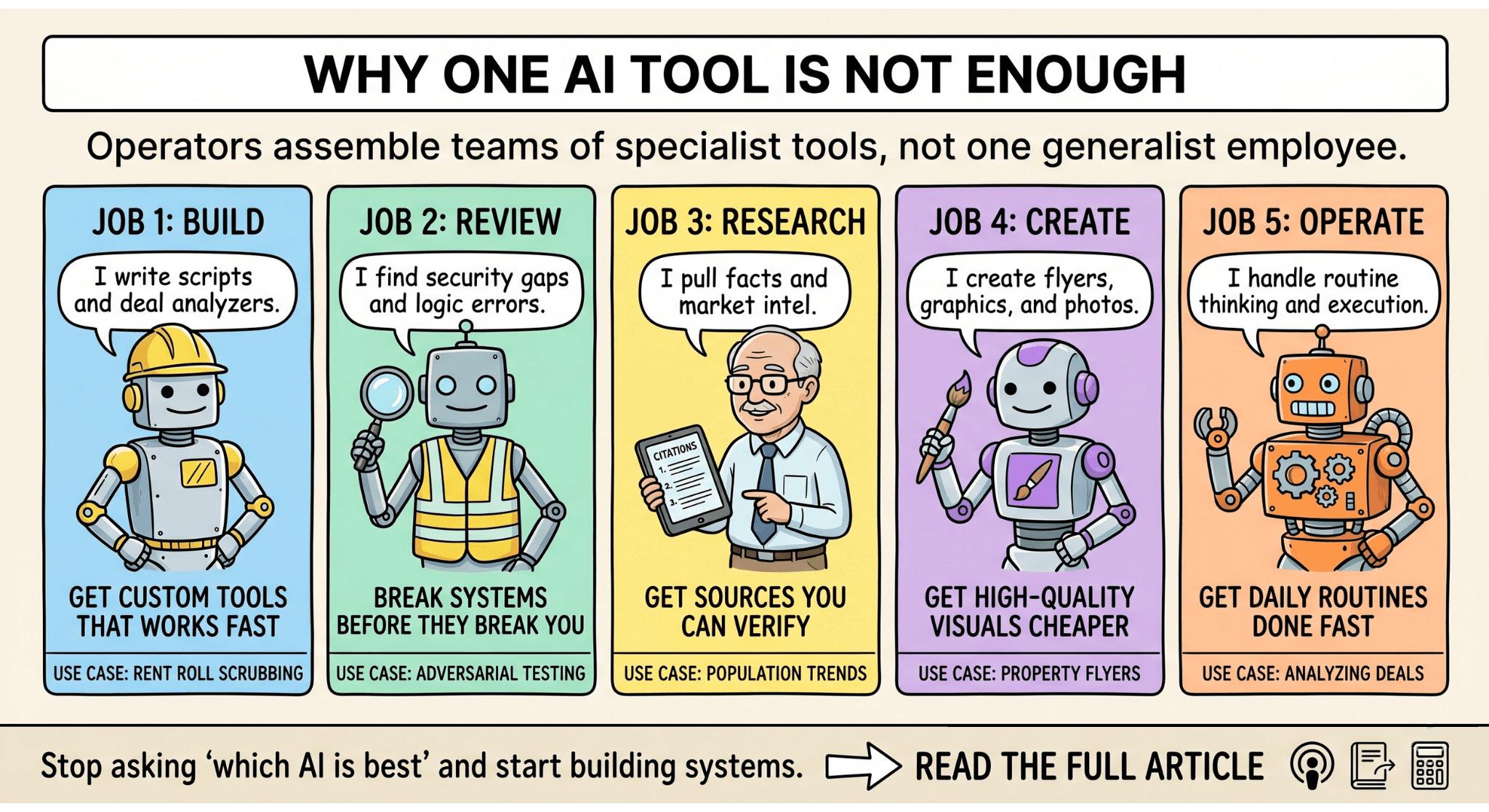
If you're running your real estate business on one AI tool, you're running it on one employee.
And one employee can't do acquisitions, underwriting, marketing, operations, and research. At least not well. And definitely not at scale.
Yet that's exactly how most investors are approaching AI. They open ChatGPT because it's the name they've heard. They ask it everything. Deal analysis. Seller letters. Comp pulls. Market research. Property flyers. And when ChatGPT gives them a mediocre answer, they blame AI. Not the setup. Not the strategy. Not the fact that they're asking one tool to do five different jobs.
I wrote about the five tools we run at Clark St Capital and Clark St Homes in the last article. This one is about why you need all five. Or something like them.
The Debate That Doesn't Matter
Every week, someone asks me "Ed, which is better, ChatGPT or Claude?"
It's the wrong question. It's like asking your carpenter if a circular saw is better than a drill. Depends what you're building.
Claude writes better than ChatGPT, especially when I take the time to give it rules and examples of how I write. Gemini's image generation beats ChatGPT's for most of the things we do here. Gemini crushes both when you're inside Google Docs or Sheets. Perplexity destroys all three when you need research with citations. None of them are as good as Codex when you need code review.
The "best AI" debate is a distraction. Usually pushed by people selling a course on one specific tool. Or influencers who picked a side because it's good for their brand.
Keep your money. I'm only here to help you avoid the mistakes I made over the past few years.
The bottom line. Operators don't pick sides. Operators pick the right tool for the job.
The Five Jobs No Single AI Does Well
Any real estate business, whether you're wholesaling, flipping, or buying value-add multifamily, has five AI jobs that need doing. Every week. Sometimes every day.
Job 1: Build. When a process breaks, the current tools suck, or a tool doesn't exist yet, someone has to build it. Deal analyzers. Lead routers. Scrubbing scripts for rent rolls. This is code work. Claude Code owns it.
Job 2: Review. When something gets built, someone has to break it before it breaks you. Security gaps. Logic errors. Assumptions that don't hold up. This is adversarial work. Codex owns it.
Job 3: Research. Before you get in the truck or write an offer, you need facts. Current facts. Population trends in New Bedford, MA. Recent zoning changes in New Britain, CT. Cap rate ranges for Class B multifamily in New Haven County, CT. You need sources you can click through and verify. Perplexity owns it.
Job 4: Create. Every direct mail piece, social graphic, flyer, and property photo needs to look like something. Designers are expensive. Gemini owns it.
Job 5: Operate. The actual daily thinking and routine execution. Analyzing a deal. Writing an email series for target property owners. Monitoring news and trends that affect your portfolio. Claude handles the thinking and some of the creating. n8n handles the routines.
Now look at those five jobs. Can ChatGPT do all five? Technically, yes. Will it do any of them as well as the best-in-class tool? Nope. Not even close.
Trying to run five jobs on one tool is the same mistake as trying to run five departments with one employee.
The Problem That Became a Product
A motivated seller in Connecticut fills out our form at 11:47 PM. They want to sell an inherited property. Here's what used to happen next.
Nothing. For hours. Sometimes days. The lead would sit in an inbox until someone on our team noticed it the next morning. By then, the seller had already talked to three other investors and signed with one of them.
We lost deals that way. Expensive deals. So we built a solution.
Today, when that seller fills out the form at 11:47 PM, our AI agent (we call her Katie) calls them back in about 37 seconds. At 11:48 PM. She asks the right qualifying questions, takes notes, and either books the meeting on my calendar or drops the lead into a follow-up sequence based on where the seller is in their decision.
By the time I wake up, Perplexity has pulled basic market intel on the property's zip code. Comps. Zoning. Recent sales. I read it with my coffee.
If the seller wants a property brief, Claude generates the document and Gemini creates the visuals. Clean. Fast. No designer.
That's the workflow. We ran an earlier version of it for our own business first. We refined it for a couple of years. We broke it and fixed it. We tested every piece. Eventually we realized every other investor we talked to had the same speed-to-lead problem we did, so we built the callback and qualification engine into proprietary software. That software is Elevista Connect.
You can build something similar yourself. Cobble together a few AI tools, a voice API, and some custom code, and you'll get something that works on most leads. What you won't easily get is two years of refinement, the proprietary callback engine we built from scratch, or the reliability that comes from running a system against thousands of real sellers.
That's not a sales pitch. That's operational math.
The Cost of Single-Tool Thinking
Here's what I see when an investor runs everything through one AI, usually ChatGPT.
The deal analysis is generic because ChatGPT doesn't know their market the way Perplexity with real-time sources would.
The seller letter sounds like ChatGPT wrote it, because Claude's nuanced writing wasn't brought to the job.
The follow-up is slow because no one built the connective tissue that n8n provides.
The marketing looks stock because Gemini wasn't asked for the creative.
And when ChatGPT confidently makes up a number, hallucinates a comp, or writes something that sounds vaguely off, there's no Codex-style second opinion to catch it.
Every single-tool investor is making five tradeoffs at once. They just don't know it because they have nothing to compare it to.
The Shift From "I Use AI" to "I Run an AI Operating System"
Here's the mindset shift.
"I use AI" is a hobby. It's trying stuff. Playing around. Maybe getting lucky on an output now and then.
"I run an AI operating system" is a business decision. It's naming the jobs that need doing and matching each one to the best tool available. It's building the connective tissue so the tools work together instead of in isolation.
Three tiers of investors are emerging in 2026.
Hobbyists bounce from hyped tool to hyped tool. They watch YouTube tutorials about the latest model and never ship anything. Their business doesn't change.
Enthusiasts pick one AI (usually whichever one their favorite creator recommends), go deep on it, and defend it online. They get some wins. Their business gets marginally better. They hit a ceiling they don't understand.
Operators build systems. They match tools to jobs. They layer them together. They hire and fire tools the same way they'd hire and fire people. When Claude upgrades, they test it. When a new tool outperforms an old one, they swap. They don't fall in love with vendors. They fall in love with outcomes.
You can guess which tier I want you in. You can also guess which tier wins over the next decade.
Where to Start
If the previous article was a map of the operating system, this one is the argument for why you need the whole thing.
You don't need all five tools today. But you do need to stop asking "which AI is best" and start asking "which AI is best for this specific job."
Start by auditing your week. Pick one hour of your Monday where you know you're doing work an AI could do better. Research? Writing? Design? Analysis? Name the job. Then pick the tool that actually specializes in that job. Not the default. The specialist.
Do that once a week for five weeks. By week five, you're running a basic operating system. By month three, you're outperforming competitors who are still arguing about ChatGPT versus Claude on LinkedIn.
What's Next
If you want the deeper playbook, the Real Estate Underground podcast unpacks how operators are building AI systems across real estate in plain, operator-level English.
If you want to start using AI in your business this week, we built a free prompt library with the exact prompts we use at the Clark St companies. 30 prompts covering deal analysis, seller letters, direct mail, market research, and more. Steal them, tweak them, make them yours.
If you want to see whether the time you're losing to manual follow-up is costing you actual deals, our lead response calculator will tell you in under two minutes.
And if you're ready to see what it looks like when the lead response piece of this operating system runs without you, that's what we built Elevista Connect for. Katie's her name. She makes the 37-second callbacks.
Operators build systems. Then they run the business.
And if I can help, give me a shout.
Get insights delivered weekly
Join real estate investors who get speed-to-lead strategies and product updates every week.