
Automated Lead Follow-Up for Real Estate: Why Your Drip Campaign Isn't Enough
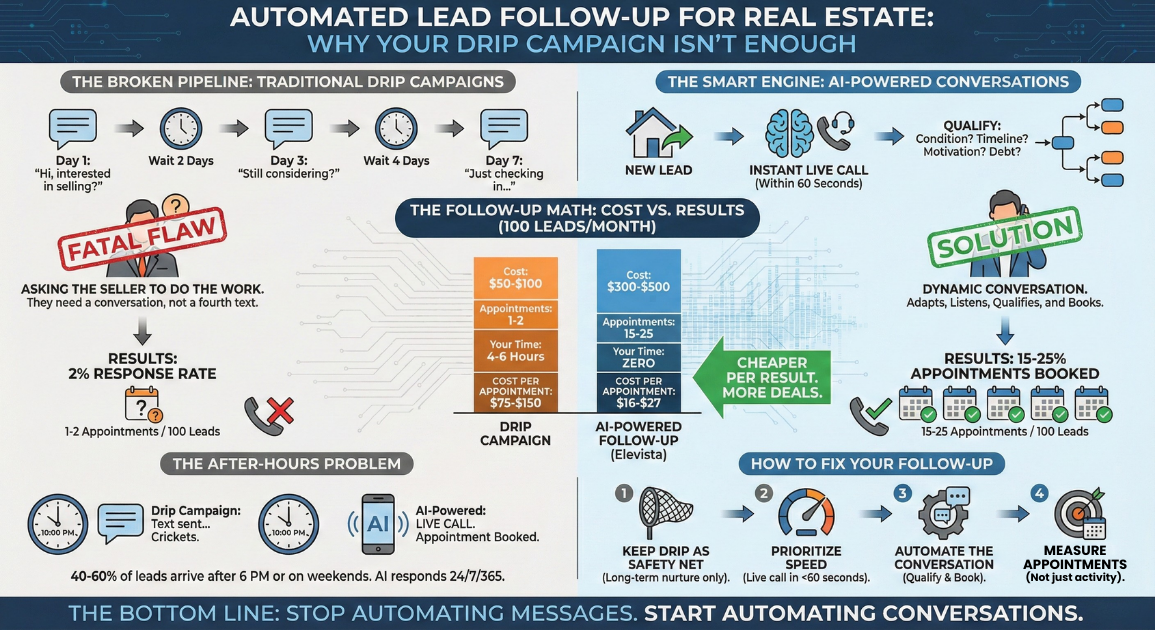
Your Follow-Up System Has a Fatal Flaw
You set up the drip campaign. Eight texts over 14 days. A couple of emails. Maybe a ringless voicemail on day three. You felt good about it. Professional. Systematic.
Then you checked your numbers and realized something uncomfortable: your drip sequence is getting a 2% response rate. Two out of every hundred leads even bother to reply. And of those two, maybe one turns into an appointment.
That's not automated lead follow-up. That's automated lead ignoring.
The problem isn't automation itself. Automation is essential—no investor can personally call every lead seven times. The problem is that most "automated" follow-up in real estate is just scheduled text blasts disguised as a system.
Real automated lead follow-up for real estate doesn't send messages and hope. It has conversations. It qualifies. It books. And it does it without you touching your phone.
Why Drip Campaigns Fail (And Everyone Pretends They Don't)
Let's be honest about what a drip campaign actually does. It sends a pre-written message to a lead at a scheduled time. That's it. No listening. No adapting. No qualifying.
Here's the typical drip sequence for a real estate investor:
Day 1: "Hi [Name], I saw you might be interested in selling your property at [Address]. Would you like a no-obligation cash offer?"
Day 3: "Just following up—are you still considering selling?"
Day 7: "Hi [Name], just checking in. We're still interested in your property."
Day 14: "Last chance—we'd love to make you a fair offer."
Every single one of those messages has the same problem: they're asking the seller to do the work. Reply to this text. Call us back. Take the next step. But motivated sellers don't want to text back and forth with a stranger. They want someone to call them, listen to their situation, and tell them what happens next.
A motivated seller with a foreclosure notice doesn't need your fourth text. They need a conversation. They need someone who asks about their timeline, their situation, and what they need to walk away. That can't happen in a drip campaign.
The data backs this up. Text-only follow-up converts at 1-3%. Phone-based follow-up converts at 15-25%. That's not a marginal difference. That's the difference between closing 1 deal a month and closing 5.
What Real Automated Follow-Up Looks Like
Actual automated lead follow-up for real estate has three components that drip campaigns completely miss:
1. Live conversation, not canned messages.
The follow-up isn't a text. It's a phone call. A real conversation where the system asks about the property, listens to the seller's situation, identifies their motivation level, and responds appropriately. Not a script that falls apart when the seller says something unexpected. A dynamic conversation that adapts to what the seller actually says.
2. Qualification built into every touchpoint.
Every follow-up attempt isn't just "are you still interested?" It's gathering information. What's the property condition? What's the timeline? What do they owe? What do they need to walk away? Each conversation moves the ball forward. By the time the seller agrees to meet, you already know their situation, motivation, and number.
3. Booking happens in the conversation, not after it.
The biggest gap in most follow-up systems: they generate "warm leads" that you then have to call, re-qualify, and schedule manually. That handoff is where deals die. Real automated follow-up books the appointment during the conversation. The seller agrees to meet. The system confirms the date, time, and address. It lands on your calendar. Done.
The Follow-Up Math Nobody Shows You
Let's run the numbers on two approaches with the same 100 leads per month.
Drip campaign approach:
- Cost: $50-$100/month (SMS platform + templates)
- Response rate: 2-3%
- Conversations generated: 2-3
- Appointments booked: 1-2
- Your time required: 4-6 hours/month chasing responses, re-qualifying, scheduling
- Cost per appointment: $75-$150 (including your time value)
AI-powered follow-up (Elevista):
- Cost: $300-$500/month
- Response rate: not applicable—every lead gets a live call
- Conversations completed: 100 (every lead, every time)
- Appointments booked: 15-25
- Your time required: zero for follow-up; you just show up to meetings
- Cost per appointment: $16-$27
The drip campaign is cheaper per month. The AI system is cheaper per result. And results are what pay your mortgage.
One wholesaler in Atlanta was running a 12-touch drip sequence he'd spent weeks building. Open rates looked fine. Click rates were decent. He was booking 3-4 appointments a month from 120 leads. He switched to Elevista for follow-up. Same leads. Same sources. First month: 19 appointments. His drip campaign wasn't broken—it was just the wrong tool for the job.
The After-Hours Problem Your Drip Campaign Can't Solve
Here's the part that really hurts. Pull your CRM data and check when your leads come in. For most investors, 40-60% of leads arrive after 6 PM or on weekends.
Your drip campaign sends a text at the scheduled time regardless. But a text at 10 PM on a Tuesday doesn't start a conversation. It starts a maybe. Maybe they'll text back tomorrow. Maybe they'll forget. Maybe your competitor called them at 10:01 PM and already has the appointment.
Automated lead follow-up that actually works doesn't care about business hours. It calls at 10 PM on Tuesday. It calls at 7 AM on Saturday. It calls on holidays. Every lead gets a live conversation within 60 seconds of submission, regardless of when they submit.
That's not a feature. That's the entire point. The leads that come in at inconvenient times are the ones your competition misses. They're your easiest wins—if you have a system that actually reaches them.
For the numbers behind why those off-hours leads matter so much, the real estate lead response time statistics tell the whole story.
How to Fix Your Follow-Up Without Starting Over
You don't have to throw out everything you've built. Here's how to layer real automated follow-up into your existing operation:
Step 1: Keep your drip as a safety net, not a strategy. Drip campaigns are fine for long-term nurture—the cold leads that aren't ready yet. But they should never be your primary follow-up for fresh leads. Fresh leads need a phone call, not a text.
Step 2: Prioritize speed on new leads. Every new lead should get a live callback within 60 seconds. That's the window where conversion rates are highest. If your current system can't do that, it's not a follow-up system—it's a reminder system.
Step 3: Automate the conversation, not just the message. The goal isn't to send more messages. It's to have more conversations. Every conversation should qualify, every qualification should lead to a decision: book the meeting, schedule follow-up, or move on.
Step 4: Measure appointments, not activity. Stop tracking open rates and response rates. Track booked appointments per lead. That's the only metric that correlates directly with closed deals. If your follow-up system generates great engagement metrics but empty calendars, it's not working.
The Bottom Line
Automated lead follow-up for real estate isn't about sending more texts faster. It's about having real conversations with every lead, at any hour, and turning those conversations into booked appointments.
Your drip campaign keeps leads warm. That's useful. But warm leads don't close deals. Booked meetings close deals. And meetings only get booked when someone picks up the phone and has the conversation.
Stop automating messages. Start automating conversations.
Try Elevista free and see what real automated follow-up does to your calendar →
Know investors whose drip campaigns are collecting dust? Join the Elevista Partner Program and earn recurring commissions every time you refer someone who's ready to stop texting and start booking.
Get insights delivered weekly
Join real estate investors who get speed-to-lead strategies and product updates every week.