
Real Estate Virtual Assistant vs AI: Which One Actually Books More Meetings?
You've Got Two Choices. One of Them Works at 2 AM.
Your leads are piling up. You're missing calls. You know you need help—so you start looking at two options: hire a virtual assistant or use an AI system.
Both promise to call your leads. Both promise to book appointments. Both promise to free up your time. But one of them sleeps, takes lunch breaks, and quits after three months.
The real estate virtual assistant vs AI debate isn't about which technology is cooler. It's about which one actually puts meetings on your calendar consistently, 24 hours a day, without you babysitting it.
Let's break this down with real numbers instead of marketing fluff.
The Virtual Assistant: What You're Actually Getting
First, let's be clear about what a real estate VA does well. A good VA can handle admin work—updating your CRM, pulling comps, managing your calendar, sending follow-up emails. That stuff is valuable.
But when it comes to calling leads and booking appointments? Here's what the VA model actually looks like:
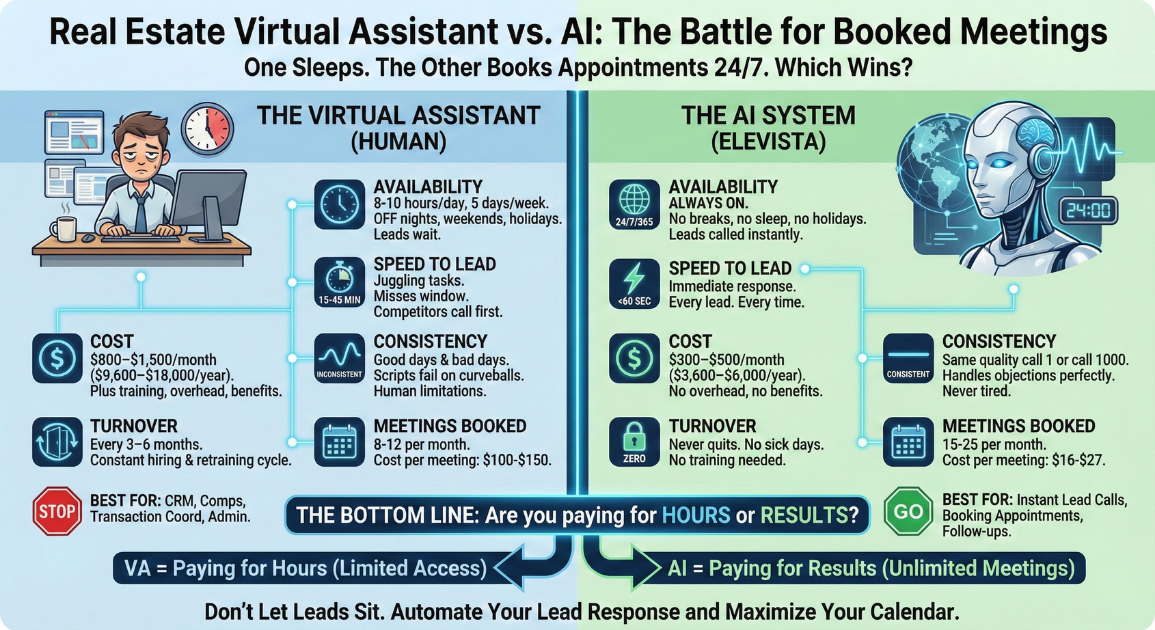
Cost: $800–$1,500/month for a dedicated lead caller. That's $9,600–$18,000 a year before you factor in training time, management overhead, and turnover costs.
Hours: 8–10 per day, 5 days a week. Your VA works when they're scheduled. Leads that come in at 10 PM on a Tuesday? They sit until morning. Leads that come in Saturday afternoon? They wait until Monday. That's 128 hours a week where nobody's answering.
Speed: 15–45 minutes on average. Even during working hours, your VA is juggling multiple tasks. They're updating records, making other calls, taking breaks. The lead that came in at 2:13 PM might not get called until 2:45 PM. By then, your competitor already had the conversation.
Quality: Inconsistent. Your VA has good days and bad days. They follow a script, but when a seller throws a curveball—"Well, my ex-husband is on the title and he lives in another state"—the script doesn't cover that. They either freeze up or give a vague answer that kills the seller's confidence.
Turnover: Every 3–6 months. This is the part nobody talks about. VA turnover in real estate is brutal. You spend 2-3 weeks training someone. They get decent after a month. They quit after three months. Now you're back to square one, leads piling up while you train the replacement.
None of this means VAs are bad. It means they're human. And humans have limitations that directly impact your bottom line.
The AI Option: What's Actually Different
Now let's look at the same metrics for an AI lead calling system like Elevista:
Cost: $300–$500/month for unlimited calls. No overtime. No benefits. No management overhead. That's $3,600–$6,000 a year—roughly a third of what a VA costs.
Hours: 24/7/365. The lead that comes in at 10 PM gets called at 10:01 PM. The lead that comes in on Christmas morning gets called on Christmas morning. There are no off-hours. There's no coverage gap.
Speed: Under 60 seconds. Every lead. Every time. No exceptions. No "I was on another call" or "I was at lunch." The system doesn't have a lunch break.
Quality: Consistent. The 50th call of the day sounds exactly like the first. It asks the right qualifying questions every time. It handles curveballs because it's been trained on thousands of real seller conversations. It doesn't get tired, frustrated, or distracted.
Turnover: Zero. It doesn't quit. It doesn't call in sick. It doesn't need a two-week vacation. It doesn't ghost you after three months because they found a better gig.
The Numbers That Actually Matter
Forget the feature comparison for a second. Here's what matters: meetings booked per dollar spent.
VA scenario:
- Cost: $1,200/month
- Hours available: 40 hours/week
- Leads called per month: ~200
- Average speed to lead: 30 minutes
- Meetings booked per month: 8-12
- Cost per meeting: $100-$150
AI scenario (Elevista):
- Cost: $400/month
- Hours available: 168 hours/week
- Leads called per month: unlimited
- Average speed to lead: 60 seconds
- Meetings booked per month: 15-25
- Cost per meeting: $16-$27
Same leads. Same market. The AI books twice the meetings at a fifth of the cost per meeting. The math isn't close.
One investor in Houston was spending $1,400/month on two part-time VAs for lead calls. They were booking about 10 appointments a month combined. He switched to Elevista. First month: 22 appointments. His cost per booked meeting dropped from $140 to $18.
For the full side-by-side breakdown of what AI costs versus a dedicated human caller, see AI vs. ISA for Real Estate.
Where VAs Still Win (And Where They Don't)
This isn't a "fire your VA" article. VAs are great for things AI shouldn't be doing:
Keep your VA for:
- CRM management and data entry
- Pulling comps and running property research
- Coordinating with title companies and buyers
- Managing your transaction pipeline
- Administrative follow-up after meetings
Use AI for:
- Instant lead callback (the speed game)
- After-hours and weekend lead response
- Initial qualification and scoring
- Appointment booking and calendar management
- Persistent follow-up sequences
The smartest operators aren't choosing one or the other. They're using AI for the thing it does best—responding instantly and booking meetings—and keeping their VA focused on the work that requires a human brain.
Your VA shouldn't be a phone jockey. They should be a transaction coordinator. Let the AI handle the calls. Let the human handle the deals.
The Question Nobody Asks
Here's the real question in the real estate virtual assistant vs AI debate: How many meetings are you missing right now because nobody answered?
Pull your CRM data from last month. Look at every lead that came in after 6 PM or on a weekend. How many got called back within 5 minutes? How many got called back at all?
For most investors, the answer is uncomfortable. Forty to sixty percent of leads come in during off-hours. If you're relying on a VA who works 9-to-5, those leads are sitting untouched for 12-15 hours minimum.
At $40-$80 per lead, that's not just an inconvenience. That's thousands of dollars a month in leads that never got a conversation.
How to Decide
Choose a VA if:
- You need 5+ leads a week and they all come in during business hours
- You have time to train and manage someone
- You're comfortable with 15-45 minute response times
- Your budget allows $1,200+/month for lead calling alone
Choose AI if:
- You need every lead called back in under 60 seconds
- A significant portion of your leads come in after hours
- You don't want to manage, train, or replace anyone
- You want lower cost per booked meeting
- You want consistent quality on every single call
Choose both if:
- You're scaling and need AI for speed plus a VA for admin
- You want the AI handling calls while the VA handles everything else
The Bottom Line
The real estate virtual assistant vs AI question comes down to one thing: are you paying for hours or are you paying for results?
A VA gives you hours. They'll work their shift and do what they can in that window. An AI gives you results—every lead called, every time, regardless of when it comes in.
You don't need someone sitting by the phone. You need meetings on your calendar. Focus on what actually gets you there.
Try Elevista free and see how many meetings AI books vs your current setup →
Know investors still hiring VAs just to make phone calls? Join the Elevista Partner Program and earn recurring commissions every time you refer someone who's ready to stop overpaying for lead response.
Get insights delivered weekly
Join real estate investors who get speed-to-lead strategies and product updates every week.