5 ChatGPT Prompts That Book You More Seller Appointments

TL;DR
- Most wholesalers use ChatGPT to write scripts. The leverage is using it to qualify, not write.
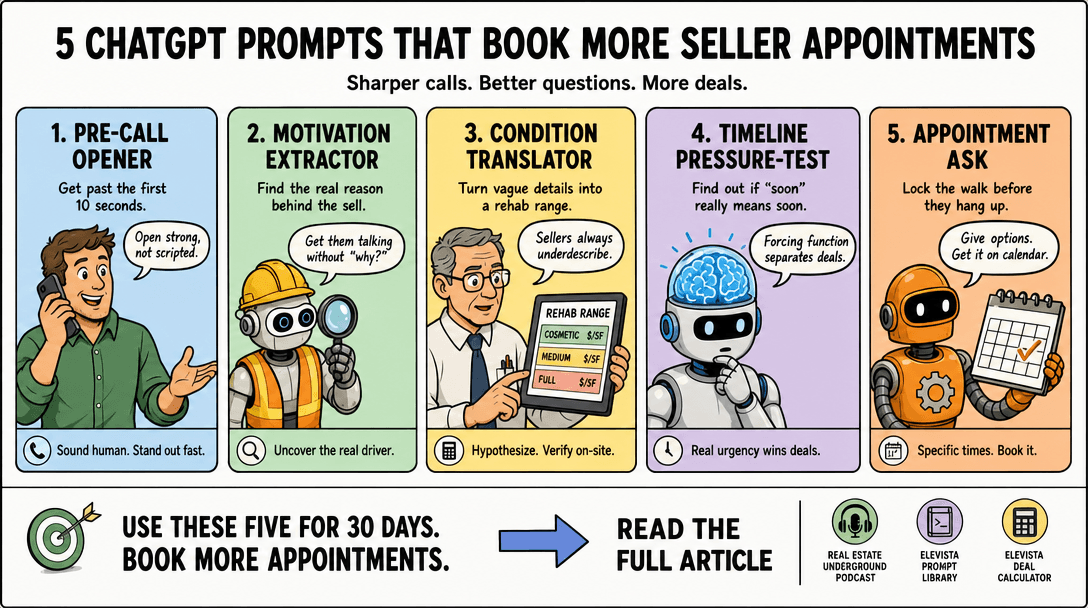
- These five prompts cover the full call: opening, motivation, condition, timeline, and the appointment ask.
- Each prompt is built around one job. Single-job prompts beat the everything-prompt every time.
- You still pick up the phone. ChatGPT preps you for the call, then helps you debrief after.
- The full 30 prompts we actually use at Clark St are in the Elevista prompt library.
How do you qualify a motivated seller on the phone?
You qualify a motivated seller in four questions: why are you selling, what condition is the property in, what is your timeline, and what is your number. A trained wholesaler can get those four answers in under 90 seconds without sounding like a survey. Anything that does not move the call toward those four answers is filler. ChatGPT will not make that call for you. But used the right way, it will sharpen every minute you spend on the phone, including the debrief after you hang up.
That is what these five prompts do.
Prompt 1: The pre-call opener
The job: Get past the first 10 seconds without sounding like every other wholesaler the seller has hung up on this week.
The prompt:
You are an experienced real estate wholesaler in [your market]. I have a motivated seller lead for a [property type] at [address]. They submitted a form on my website at [time]. Give me three different opening lines I can use on the callback. Each opener should be under 15 words, sound like a real person, and assume the seller has been called by five other wholesalers this week. No corporate language. No "I came across your property." Make me sound like the person they actually want to talk to.
Why this works: "I came across your property" tells the seller you are a robot or a script. The seller knows. They have hung up on that opener four times today. ChatGPT, given the right constraint, will write you three openers that sound human. You pick the one that fits your voice and use it on the next call. The constraint matters more than the prompt. "Under 15 words, no corporate language, assume they have been called five times today" is the prompt doing the work.
Prompt 2: The motivation extractor
The job: Find out why the seller is actually selling without asking "why are you selling?"
The prompt:
I am about to call a seller at [address] who said on the form: "[paste their form notes verbatim]." I need three open-ended follow-up questions that will get them talking about their real motivation without me asking "why are you selling?" directly. The goal is to find out if this is a divorce, a death, a job move, a tax problem, a tenant issue, or a delayed maintenance situation. Each question should be conversational. None should sound like a script. Order them from least invasive to most invasive.
Why this works: "Why are you selling?" gets you "I just want to sell." That is not information. That is the seller giving you the brush-off. The real motivation lives one layer below the form. ChatGPT will give you three questions that get there without tripping the script alarm. The "least invasive to most invasive" instruction is the part that makes the output usable, because it lets you escalate based on what the seller volunteers in the first 30 seconds.
Fact block. Investors who respond to a website lead in under five minutes close significantly more deals than investors who wait an hour or more. The window between "I need to sell" and "I'll think about it" is roughly five minutes. Anything past that, the seller has cooled off, called their brother-in-law, or fielded another offer.
Prompt 3: The condition translator
The job: Turn the seller's vague description of the property into a defensible rehab range before you walk the property.
The prompt:
I just got off the phone with a seller. Here is what they said about the property: "[paste your notes]." The property is a [year built] [property type] in [zip code], [square footage] square feet. Based on what the seller described, give me a rehab range in three buckets: cosmetic (paint, flooring, cleanup), medium (kitchen, baths, some mechanicals), and full (mechanicals, roof, layout changes). Give me a per-square-foot estimate for each bucket using [your market]'s 2026 cost basis. Flag the three things in the seller's description that are most likely understated. Tell me which bucket this property probably falls into and why.
Why this works: Sellers underdescribe. Always. "Cosmetic" from a homeowner means "needs a full rehab." "Needs some work" means "we have not opened that bedroom in two years." ChatGPT will not give you a real number, and you should not trust it for the offer math. But it will pattern-match the seller's words to a bucket and tell you what they probably left out. That is enough to walk the property with the right tools and a useful hypothesis instead of a guess. The actual offer math goes through a real deal calculator like the Elevista deal calculator, not a chatbot.
Want the full conversation? Ed walks through the seller-call playbook in more detail on the Real Estate Underground podcast, including the live debrief of a deal that closed because of a five-minute callback.
Prompt 4: The timeline pressure-test
The job: Find out whether the seller's stated timeline is real, or whether they will be "thinking about it" for six months.
The prompt:
I have a seller at [address] who told me they want to sell "soon." I need to find out what "soon" actually means. Give me four follow-up questions I can ask in the next call that will reveal whether their timeline is 30 days, 90 days, six months, or never. Each question should sound conversational and give the seller a reason to be specific. Two of the four should reveal a forcing function (a court date, a job start, a tax deadline, a lease end). The other two should reveal a non-forcing function ("when we get around to it").
Why this works: "Soon" is the seller hedging. You need to know if they have a court date in 30 days or if they are just bored on a Tuesday. The forcing function is what separates a wholesale deal from a wholesale tire-kicker. The prompt structure forces ChatGPT to produce questions that reveal real urgency, not just polite urgency.
Prompt 5: The appointment ask
The job: Move from "we should talk again" to a calendar event before the seller hangs up.
The prompt:
I am closing a call with a motivated seller at [address]. They are at the [low / medium / high] motivation level. The condition is [your assessment]. The timeline is [30 / 90 / 180 days]. Give me three different ways to ask for the appointment to walk the property. Each one should assume the seller is comparing me to two other investors. Each one should give a specific time option, not "when are you free." Each one should sound like one operator talking to another homeowner, not a salesperson closing a deal.
Why this works: "Let me know when you are free" is how appointments die. "I can be there Thursday at 4 PM or Friday at 9 AM, what works better?" is how appointments get booked. ChatGPT, given the seller's motivation level and timeline, will produce three asks calibrated to where the seller actually is on the call. You pick the one that fits. The seller picks a time. The appointment is on the calendar before they hang up.
Why this article is not 30 prompts
Because most prompt libraries are noise. Most wholesalers do not need 30 prompts. They need a handful they actually use, every call, every week, until the muscle memory replaces the prompt.
The five above cover the full call from opener to appointment. If you run these five for 30 days, you will book more appointments. Not because ChatGPT is magic. Because you stopped winging the parts of the call you used to wing.
The other 25 we use at Clark St handle the post-call work: follow-up sequences, dispo emails, buyer outreach, market research, comp triangulation, contract redlines, and a few we use specifically for stalled deals. Those are in the prompt library.
The part the prompts cannot do
ChatGPT will not call the seller. It will not pick up the phone in 60 seconds when the lead comes in at 2:47 PM on a Tuesday. It will not handle the 9 PM lead while you are putting your kids to bed.
That is a different problem. We have written about it before in our work on speed to lead. The short version: the wholesaler who calls the seller back first wins the deal a disproportionate amount of the time. ChatGPT helps you run a better call. Something else has to make sure the call actually happens.
That second piece is what we are building at Elevista. More on that soon.
What to do today
Open ChatGPT. Paste prompt 1. Fill in your market and your lead. Save the three openers somewhere you will find them on your next callback.
Then do the same for prompts 2 through 5.
Total time: 20 minutes. You will be a sharper operator on the phone tomorrow than you were today.
Get the full prompt library. These five prompts are five of 30 we actually use at Clark St. The full library is at elevista.com/prompts. Free, no signup, and each prompt comes with the reasoning behind why it works.
Also free:
- Real Estate Underground podcast — operator-level conversations on running a real estate business in 2026, including specific episodes on the seller-call playbook.
- Elevista deal calculator — MAO, ARV, and rehab math on any deal in under two minutes.
Get insights delivered weekly
Join real estate investors who get speed-to-lead strategies and product updates every week.