Speed to Lead: Why 60 Seconds Wins Real Estate Deals

Does Being the First Call Really Matter?
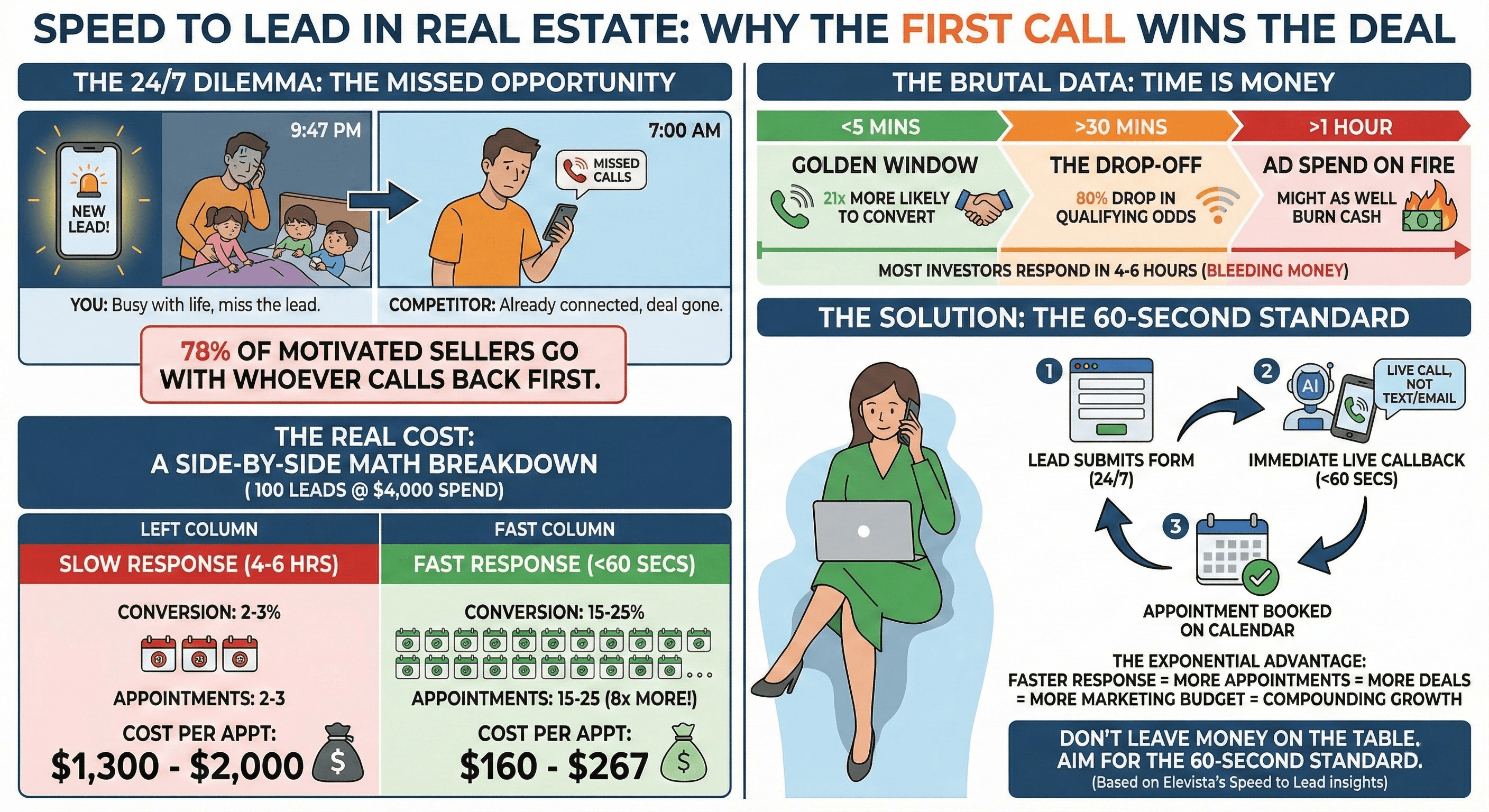
You spent $80 on a motivated seller lead. They filled out your form at 9:47 PM. You were putting the kids to bed. By the time you saw it at 7 AM, they'd already talked to three other investors.
That deal? Gone.
The First-Caller Advantage
This is the speed to lead problem in real estate. And it's costing you more than you think.
The data is brutal. According to lead-response research published in Harvard Business Review, 78% of motivated sellers go with whoever calls them back first. Not whoever has the best offer. Not whoever has the most experience. The first person who picks up the phone and sounds like they know what they're doing.
That's it. Speed wins.
Why This Applies to Every Lead Source
Whether your leads come from Facebook ads, Google PPC, direct mail, or referral sites, the pattern holds. The seller filled out a form because they have a problem right now. The investor who responds while that urgency is fresh gets the conversation. Everyone else gets voicemail.
What Is Speed to Lead and Why Should You Care?
Speed to lead measures the time between when a lead submits their information and when you make first contact. In real estate investing, this window is everything.
The 5-Minute Conversion Data
Here's what the numbers say:
- Leads contacted within 5 minutes are 21x more likely to convert than leads contacted after 30 minutes.
- After 30 minutes, your odds of qualifying that lead drop by over 80%.
- After 1 hour, you might as well light that ad spend on fire.
Why Most Investors Fall Behind
Most real estate investors respond to leads in 4-6 hours. Some take a full day. A few "get to it when they can." Every one of those investors is bleeding money.
The problem isn't motivation. It's logistics. You're driving to appointments. You're on the phone with a contractor. You're at your kid's baseball game. You can't physically be available every time a lead comes in.
But your competition? They figured it out.
How Much Does a Slow Lead Response Actually Cost?
A slow response doesn't just lose one deal. It drains your entire marketing budget of its potential return. Let's do the math that nobody wants to do.
The Ad Spend Breakdown
Say you're running Facebook ads and paying $40 per motivated seller lead. You generate 100 leads a month. That's $4,000 in ad spend.
Industry research shows the average real estate investor responds in 4-6 hours. At that response time, you're converting maybe 2-3% of those leads into appointments.
That's 2-3 appointments from $4,000 in spend. Roughly $1,300-$2,000 per appointment.
What 60-Second Response Changes
Now look at what happens when you respond in under 60 seconds:
Conversion rates jump to 15-25% on the same leads. Same ad spend. Same quality leads. The only difference is speed.
That's 15-25 appointments from the same $4,000. Your cost per appointment drops to $160-$267.
The 8x Multiplier
Same leads. Same budget. 8x more appointments. The only variable that changed was how fast you called back.
This is why speed to lead in real estate isn't a nice-to-have. It's the single biggest lever you can pull in your business right now.
Why Can't Most Investors Fix This Problem on Their Own?
You already know you should call leads faster. That's not news. The problem is execution, and every common solution falls short.
Hiring a VA
You pay someone $5-$10/hour to sit by the phone. They work 8 hours a day, maybe 10. What happens at 11 PM when that motivated seller fills out your form? What happens on Sunday morning? The VA is off. The lead is gone.
Hiring an ISA
Better than a VA, but expensive. A good ISA costs $3,000-$5,000/month before commissions. And they still can't work 24/7. They call in sick. They quit. They have bad days where they sound like they'd rather be anywhere else.
Setting Up Drip Campaigns
You send automated texts and emails. The lead gets a message that says "Thanks for reaching out! Someone will call you soon." Meanwhile, your competitor just called them live, had a real conversation, and booked a meeting for Thursday.
Drip campaigns don't book meetings. Phone calls do.
Doing It Yourself
You try to be the person who calls every lead within 5 minutes. It works for a week. Then you're in an appointment and miss three leads. Then you're exhausted and turn your phone off at 9 PM. The leads don't stop coming at 9 PM.
None of these solutions actually solve the speed to lead problem in real estate. They just put a band-aid on it.
What Does the 60-Second Standard Look Like in Practice?
Immediate, live callback on every single lead, 24 hours a day, 7 days a week. That is the standard that actually moves the needle.
How It Works
Not a text. Not an email. Not a "we'll call you back." A live phone call within 60 seconds of form submission.
Lead comes in at 2:47 PM? Call connected at 2:48 PM. Meeting booked for Thursday.
Lead comes in at 10:30 PM on a Saturday? Call connected at 10:31 PM. Seller qualified. Appointment set for Monday morning.
Real-World Results
Elevista does exactly this. Our AI calls your leads back within 60 seconds, every lead, every time, day or night. It doesn't sound like a robot. It sounds like a member of your team. It qualifies the seller, gauges motivation, and books the appointment directly on your calendar.
You wake up to booked meetings. That's it.
Why After-Hours Leads Are the Biggest Opportunity
According to industry data from the National Association of Realtors, 40-60% of real estate leads arrive after 6 PM or on weekends. These are often the highest-motivation sellers, people sitting at home stressed about a foreclosure or a vacant property. Capturing these after-hours leads while your competition sleeps is where the biggest wins happen.
How Can You Implement Speed to Lead Today?
Whether you use Elevista or not, here's how to start closing the speed to lead gap right now. The key is removing yourself as the bottleneck.
Step 1: Measure Your Current Response Time
Check your CRM. When did the last 10 leads come in, and when did you first contact them? Be honest. The number is probably worse than you think.
Step 2: Set a Target
Under 5 minutes is good. Under 60 seconds is where the money is. The Harvard Business Review study on online sales leads confirmed that firms responding within an hour were 7x more likely to qualify leads than those waiting even one hour longer.
Step 3: Eliminate the Bottleneck
The bottleneck is you. You can't be available 24/7. You need a system, whether that's an AI like Elevista Connect, a round-the-clock team, or some combination that guarantees instant response regardless of when the lead comes in.
Step 4: Track the Results
Compare your appointment-to-lead ratio before and after implementing faster response. The difference will make your ad spend look like the best investment you've ever made.
Frequently Asked Questions
How fast should I respond to real estate leads?
Research shows leads contacted within 5 minutes are 21x more likely to convert than those contacted after 30 minutes. The gold standard is under 60 seconds, which produces 15-25% appointment conversion rates. Every minute you wait, conversion drops significantly.
What is speed to lead in real estate?
Speed to lead measures the time between when a lead submits their information and when you make first contact. In real estate investing, faster response times directly correlate with higher conversion rates and lower cost per appointment. The industry average of 4-6 hours puts most investors in the 1-2% conversion range.
Why can't I just text leads instead of calling?
Phone conversations convert 5-8x better than text messages for initial contact. A 60-second callback beats a 5-second text every time because it catches the seller while they are still actively thinking about their situation. Texts feel impersonal, and they don't build the rapport needed to book an appointment.
How much does slow lead response cost real estate investors?
At a 4-6 hour response time, investors convert roughly 2-3% of leads into appointments. Responding in under 60 seconds pushes that to 15-25%. On a $4,000 monthly ad spend, that's the difference between 2-3 appointments and 15-25 appointments from the same budget.
Can a VA or ISA solve the speed to lead problem?
Not fully. A VA covers 8-10 hours a day, leaving nights, weekends, and holidays with zero coverage. An ISA costs $3,000-$5,000 per month and still cannot work 24/7. Neither solution eliminates the after-hours gap where 40-60% of leads arrive.
What's the Bottom Line on Speed to Lead?
Speed to lead in real estate isn't complicated. The first call wins. The data proves it. The math proves it. Every investor who's figured this out is eating the lunch of every investor who hasn't.
You're already paying for the leads. You're already running the ads. The only question is whether you're going to keep letting those leads sit while your competition calls them first.
Or you can be the first call. Every time. In 60 seconds or less.
Try Elevista free and see how many meetings you've been missing
Know other investors who are losing deals to slow follow-up? Join the Elevista Partner Program and earn recurring commissions every time you refer someone who's tired of watching leads walk away.
Frequently Asked Questions
How fast should I respond to real estate leads?
What is speed to lead in real estate?
Why can't I just text leads instead of calling?
How much does slow lead response cost real estate investors?
Can a VA or ISA solve the speed to lead problem?
Get insights delivered weekly
Join real estate investors who get speed-to-lead strategies and product updates every week.