We Stopped Using Crappy Flip Software. We Built Our Own With AI.

TL;DR
- Most fix-and-flip software is a dressed-up spreadsheet with a sales team.
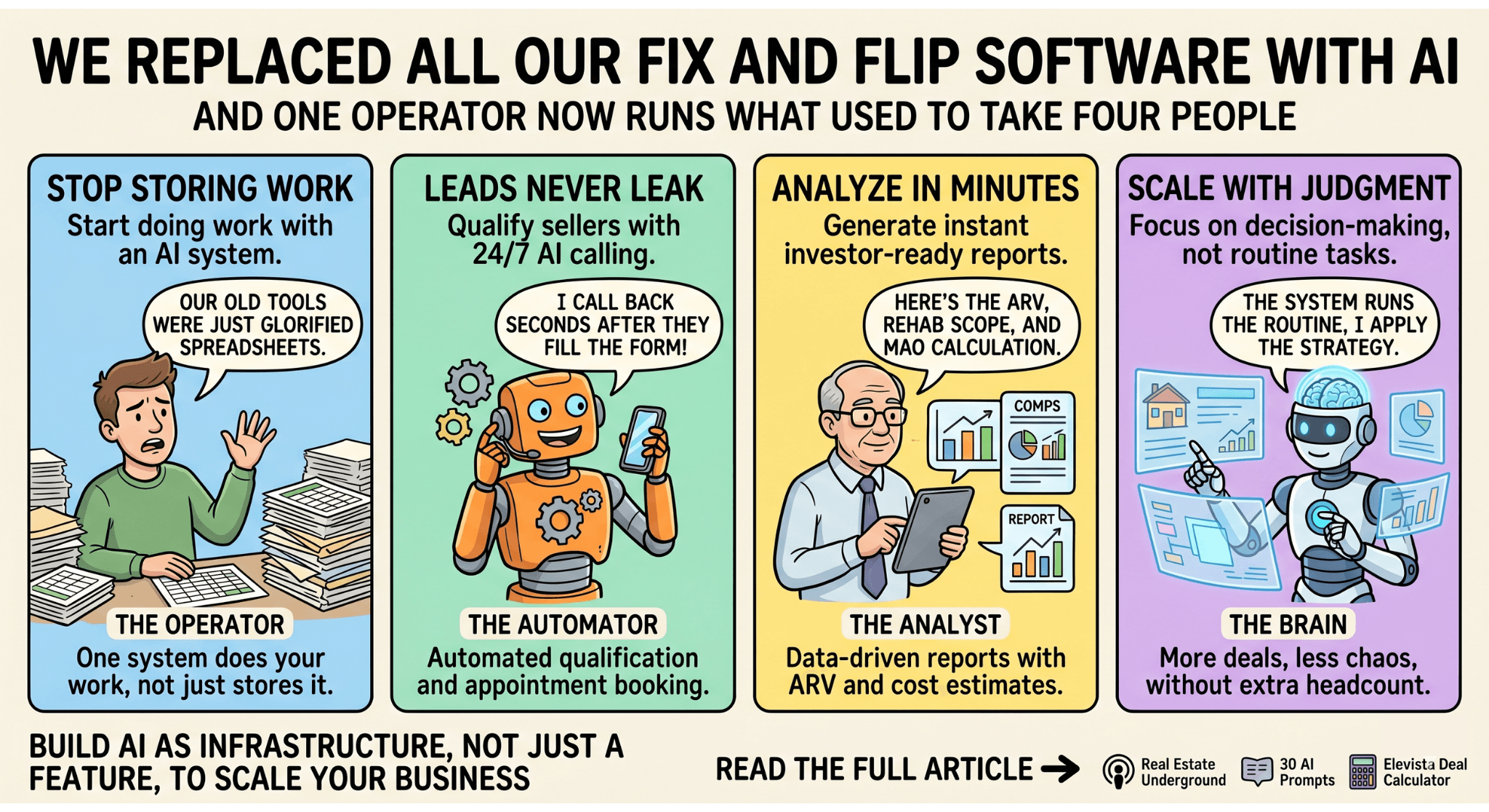
- We built our own AI system that runs the entire flip lifecycle: lead, qualification, evaluation, due diligence, offer, project management.
- One operator can now run what used to take a team of four.
- The point isn't the software. The point is what's now possible for any operator who treats AI as infrastructure, not a feature.
- A public version of this system is coming.
We tried every flip platform on the market. They were all the same.
Every fix-and-flip software we evaluated was a glorified spreadsheet with a logo and a monthly fee. They tracked leads, stored comps, and printed offer letters. None of them actually did the work. We were still the ones calling the leads, scoping the rehab, pulling the comps, building the offer, and chasing the contractors. The software was a filing cabinet with a pretty interface.
So we stopped paying for filing cabinets and built what we actually needed.
What does an AI fix-and-flip system actually do?
It runs the deal. End to end. From the moment a seller submits a lead on our acquisitions site to the day we close on the property and start swinging hammers.
The system we built handles nine functions that used to require either software stitching or a person doing the work manually. Lead intake. Voice qualification. Onsite property evaluation. Rehab scoping. Comp analysis and ARV. Cost estimation and MAO. Investor-ready reports. Offer generation. Project and vendor management.
That's the whole flip. The software doesn't assist us. It does the work and hands us the decisions.
The shift in one line: Old software stored your work. The new system does your work.
How does it run a deal from lead to close?
A motivated seller fills out the form on our Clark St Homes site. Within seconds, the AI voice agent calls them back, has a real conversation, qualifies the lead against our criteria, and either books an appointment with one of our acquisition managers or drops them into a nurture sequence. The seller doesn't wait. We don't miss the call. The lead doesn't leak. This is the single biggest leverage point in the entire system, and we'll come back to it at the end.
When we walk the property, the system gives us a structured evaluation checklist on a phone: every system, every defect, every cosmetic line item. We answer the questions and snap photos. The system takes that input and produces a rehab plan with scoped line items.
Then it pulls comps from national property data, calculates the ARV, costs the rehab against current local labor and material rates, and runs the MAO. The output is a full investor-grade deal report with photos and numbers, the kind of document that used to take an analyst half a day. The system builds it in minutes.
If the deal works, the system drafts the offer. Cash, seller financing, or traditional financing, whichever fits the seller's situation. The acquisition manager reviews, edits if needed, and sends.
After the contract is signed, the same system runs the project. Vendor assignments. Task lists. Reimbursement requests. Disbursement tracking. The kanban board updates itself as work moves.
What is now possible because of this?
Scale without complexity. That's the whole story.
For most operators, scaling a flip business means hiring acquisition managers, project managers, and analysts, and then hiring the manager who manages them. Headcount creates coordination overhead, which creates more headcount. The business gets bigger and harder to run at the same time.
AI changes that math. The work that used to require a team of people is now executed by a system that runs 24 hours a day, doesn't forget anything, doesn't miss a callback, and produces consistent output every time. The operator becomes the person who makes decisions and applies judgment, not the person who chases leads, calculates comps, and follows up with contractors.
We're running more deals with fewer people. The team we have is doing higher-leverage work. The chaos that used to live in spreadsheets, email threads, and group texts now lives in one system that talks to itself.
Want to hear how this kind of system gets built in the real world? On the Real Estate Underground podcast, we sit down with operators who are pulling levers like this in their own businesses.
Why did we build it ourselves instead of waiting?
Because the tools to build it exist now, and the cost of waiting is real money. Every quarter we ran the old way was a quarter of leaks, missed callbacks, and slow analysis. The math wasn't close.
We also wanted infrastructure we control. When you build on top of off-the-shelf software, you inherit their roadmap, their pricing decisions, and their definition of what your business should look like. When you build your own, the system shapes itself around how you actually operate.
The technology used to do this (Claude Code, modern AI agents, structured data tooling) wasn't sci-fi. It was a few weeks of focused work by an operator who knew exactly what the business needed. That's the part most people miss. The hard work isn't writing the software anymore. The hard work is knowing what the software should do, because you've spent years doing it by hand.
What does this mean for the rest of the industry?
The fix-and-flip software market is about to look different.
The vendors who built filing cabinets with monthly fees are going to be replaced by systems that actually execute the work. The operators who treat AI as infrastructure (not a feature, not a chatbot bolted onto their CRM) will run circles around the ones who don't. Headcount will stop being the proxy for scale. Quality of system will be.
We're not the only ones who see this. We're just one of the early ones building it.
A public version of what we built is coming. We're not naming it yet, and we're not opening a waitlist. But if you're an operator who's tired of paying for spreadsheets with logos, keep an eye on what's coming out of Elevista this year.
Where to start: solve speed-to-lead first.
The first leak in every flip business is the same one. A motivated seller fills out a form, picks up the phone, or sends a text. The clock starts. InsideSales research found that contacting a lead within 60 seconds gives you a 391% better chance of closing the deal. The math isn't subtle. It's the single highest-leverage problem in the entire acquisition funnel.
Most investors try to solve it with people. VAs. Inside sales agents. A cousin who needs a job. The problem is that people take sick days, take vacations, sleep at night, and want raises. The average investor responds to a new lead in roughly two hours during business hours. Off-hours, response time is measured in days. A motivated seller who fills out your form on Friday night gets a call on Monday morning, if they get one at all. By then they've called three other investors and signed with whoever picked up first.
The front end of our flip system (the part that catches the lead, calls back in seconds, qualifies, and books the meeting) is Elevista Connect. Connect is available today, and it's the same front door we use on our own deals. It runs 24 hours a day, seven days a week, and never asks for a raise. When the rest of the flip system goes public, Connect is what feeds it.
If you do nothing else from this article, fix speed-to-lead. It's the biggest leak in the funnel and the easiest to plug.
Try Elevista Connect free for 14 days →
Also free:
- Real Estate Underground podcast: operator interviews on how the best in the business actually run their deals.
- Elevista deal calculator: fast ARV and MAO math for your next property walk.
- 30-prompt AI library: the prompts we actually use across acquisitions, due diligence, and project management.
Get insights delivered weekly
Join real estate investors who get speed-to-lead strategies and product updates every week.