Lead Nurturing Automation: Stop Nurturing, Start Closing

Are You Nurturing Leads That Don't Need Nurturing?
Most likely, yes. You built the funnel. Lead comes in, gets tagged, enters a 45-day email sequence. Drip, drip, drip. Educational content. Case studies. Testimonials. A calendar link in every email. The whole nurture machine humming along in the background.
Sixty days later, you check the numbers. Two hundred leads entered the sequence. Fourteen opened more than two emails. Three clicked the calendar link. One booked a meeting. One.
Speed Problems Disguised as Nurturing Problems
You didn't have a nurturing problem. You had a speed problem disguised as a nurturing problem. The leads that needed immediate action got slow automation instead.
Why Automating Urgency Beats Automating Patience
Real estate lead nurturing automation isn't broken because the tools are bad. It's broken because most investors automate the wrong thing. They automate patience when they should automate urgency.
Why Does the Traditional Nurturing Model Fail for Real Estate?
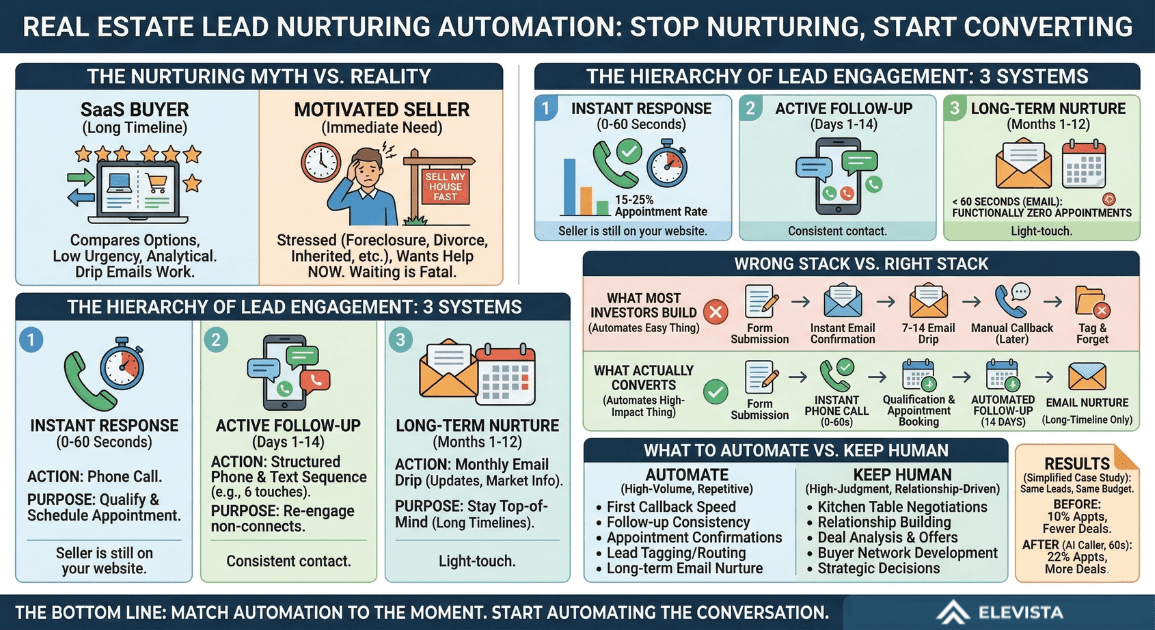
Because motivated sellers have high urgency that doesn't match a slow drip approach. Nurturing works in industries where buyers browse. A SaaS company selling project management software? Their buyer is comparing five tools over three weeks. Drip emails that educate and differentiate make sense. The timeline is long. The urgency is low. The decision is analytical.
Motivated Sellers Aren't Browsing
A motivated seller filling out a "sell my house fast" form is not browsing. They're stressed. They're dealing with a foreclosure, a divorce, an inherited property, a vacancy that's bleeding money. They filled out the form because they want help now. Not in 45 days. Not after they've read your seven-email education series.
Matching Your Response to Seller Intent
Putting that seller into a nurture sequence is like putting someone who called 911 into a queue for a wellness newsletter. The intent doesn't match the response.
The data confirms it. According to lead response research published in Harvard Business Review, leads contacted by phone within 60 seconds convert to appointments at 15-25%. Leads who receive a nurture email within 60 seconds? The appointment rate is functionally zero. Not because the email was bad. Because the channel was wrong for the moment.
Real estate lead nurturing automation needs to start with a conversation, not a campaign. The speed to lead framework is what fresh leads actually need before any nurture sequence touches them.
What Should Automation Actually Do for Real Estate Leads?
It should respond to every lead at the right speed, through the right channel, with the right action. Strip the word "nurturing" out of the equation. What you need is automated lead engagement.
Phone First for Fresh Leads
For a fresh lead, that means a phone call in under 60 seconds. Not an email. Not a text. A phone call. The seller's phone rings while they're still on your website. A live conversation happens. The lead gets qualified or scheduled for follow-up. Research from Harvard Business Review on the short life of online sales leads confirms that speed of response is the single biggest factor in making contact.
Structured Phone/Text Follow-Up for Non-Connects
For a lead who didn't answer the first call, that means a structured follow-up sequence: phone calls and texts over 14 days. Six touches. Every lead. No exceptions. No "I'll get to it tomorrow."
Email Nurture Only for Long-Timeline Leads
For a lead who's qualified but not ready for 6-12 months, that's where email nurturing finally makes sense. Monthly check-ins. Market updates. A simple "still thinking about selling?" Low-effort, low-cost, long-horizon. Email is the right tool for this job because the urgency is gone and you're just staying top of mind.
The hierarchy matters. Phone first for hot leads. Phone and text for warm leads who didn't connect. Email for leads that are months away. Most investors have this backwards. They put every lead into email and hope the hot ones self-select into booking a meeting. They don't. They call your competitor who picked up the phone.
How Much Does Slow Nurturing Actually Cost You?
Industry case studies suggest it can cost you more than half your potential deals. An investor in Indianapolis was running what he considered a solid real estate lead nurturing automation stack. New lead comes in, gets an instant email confirmation, enters a 30-day drip sequence, and gets a manual callback within 2-4 hours.
Surface-Level Numbers vs. Real Potential
His numbers looked reasonable on the surface. 120 leads a month. 12 appointments. 4 deals. He thought his 10% lead-to-appointment rate was normal.
The 60-Second Experiment
Then he ran an experiment. For 30 days, he routed every new lead to an AI calling system that dialed within 60 seconds instead of sending the email confirmation. The drip sequence still ran in the background for leads that didn't convert on the first call. But the first touchpoint changed from email to phone.
The results weren't marginal. They were structural. Lead-to-appointment rate went from 10% to 22%. Appointments went from 12 to 26. Deals went from 4 to 8. Same leads. Same budget. The only thing that changed was the first 60 seconds.
Email Still Has Its Place
His email nurture sequence was still running. It just wasn't the first thing leads experienced anymore. And the leads who ended up in the email sequence were the ones who genuinely needed long-term nurture, not the ones who needed a phone call three minutes ago.
How Should You Build an Automation System That Matches Intent?
By layering three separate systems, each matched to a different level of lead urgency. The best real estate lead nurturing automation isn't one system. It's three systems working together.
System 1: Instant Response (0-60 Seconds)
Every new lead gets a phone call within a minute. This isn't nurturing. This is responding. The call qualifies the lead: property details, timeline, mortgage, motivation, decision makers. If they qualify, the appointment gets booked during the call. If they don't answer, they move to System 2. Forrester Research on lead nurturing consistently finds that the speed of first contact is the strongest predictor of conversion.
System 2: Active Follow-Up (Days 1-14)
The lead who didn't pick up gets a structured sequence. Call again in 4-6 hours. Call the next day at a different time. Text on day 3. Call on day 7. Final touch on day 14. Six contacts through channels the seller actually checks: their phone. This is where most deals that don't close on the first call get rescued.
System 3: Long-Term Nurture (Months 1-12)
The lead who answered the phone, had a conversation, but said "I'm six months out." Or the lead who went through the full 14-day follow-up without converting. These leads go into a monthly email drip. Light, low-effort, keeping your name in front of them for when the timing changes. This is where email nurturing actually belongs.
Real Results From a Three-System Approach
An investor in Milwaukee was spending $400/month on email nurture software and attributing 2 deals per quarter to the nurture sequence. When he added instant callback and phone follow-up as the first two layers, his quarterly deal count from the same lead sources went from 8 to 17. The email nurture still contributed its 2 deals from long-timeline leads. But the phone systems added 7 more that were converting before the emails ever got opened.
He didn't kill his email nurture. He put it in its proper place: third in line, not first.
What Does the Typical Automation Stack Get Wrong?
Most investors automate the easy thing (email) and leave the hard thing (phone calls) to human willpower. Here's the typical real estate lead nurturing automation setup compared to what actually converts:
The Common (Broken) Setup
Form submission, instant email confirmation, 7-14 email drip sequence, manual callback when they get around to it, CRM tag and forget.
The Setup That Actually Converts
Form submission, instant phone call (under 60 seconds), qualification and appointment booking, automated phone/text follow-up for non-connects (14 days), email nurture for long-timeline leads only.
The difference isn't technology. Both setups use automation. The difference is channel and timing. The first setup automates the easy thing and leaves the hard thing to human willpower. The second setup automates the high-impact thing (instant phone contact) and reserves email for its actual strength: long-term maintenance.
What Should You Automate vs. Keep Human?
Automate the high-volume, time-sensitive, repetitive work. Keep humans on the high-judgment, relationship-driven tasks. Not everything should be automated. Here's the split:
What to Automate
First callback (speed matters more than personality). Follow-up sequence (consistency matters more than creativity). Appointment confirmations (industry estimates suggest this reduces no-shows by 30-40%). Lead tagging and routing. Long-timeline email nurture.
What to Keep Human
Kitchen table negotiations. Relationship building with sellers. Deal analysis and offer structuring. Buyer network development. Strategic decisions about markets and scaling.
The automation handles the high-volume, time-sensitive, repetitive work. You handle the high-judgment, relationship-driven, revenue-producing work. That's the split that scales.
Elevista automates Systems 1 and 2: the instant callback and the 14-day follow-up sequence. Every lead gets called in under 60 seconds. Every non-connect gets the full follow-up treatment. Qualified leads land on your calendar with full details. Your email nurture platform handles System 3 for the long-timeline leads that need months of light-touch contact.
You show up to qualified appointments with sellers who are ready to talk. That's the only part of the process that requires you.
Frequently Asked Questions
Why doesn't email nurturing work for fresh real estate leads?
Fresh leads from motivated sellers have high urgency. They filled out a form because they want help now, not in 45 days. According to Harvard Business Review research, leads contacted by phone within 60 seconds convert to appointments at 15-25%, while leads who receive a nurture email within 60 seconds have a near-zero appointment rate. The channel is wrong for the moment.
What is the right automation sequence for real estate leads?
The best approach uses three systems: instant phone callback within 60 seconds for fresh leads, structured phone/text follow-up over 14 days for non-connects, and email nurture only for leads 6-12 months out. Phone first, text second, email third.
How much can instant callback improve my lead-to-appointment rate?
Industry case studies show that switching the first touchpoint from email to an instant phone call can more than double appointment rates. Investors have reported going from 10% to 22% lead-to-appointment rates simply by adding a 60-second callback as the first contact.
Should I get rid of my email nurture sequence entirely?
No. Email nurture still has value for long-timeline leads (6-12 months out) who have been contacted by phone first but aren't ready yet. The key is putting email in its proper place: third in line after instant callback and phone/text follow-up, not first.
What parts of real estate lead follow-up should stay human?
Keep human involvement for kitchen table negotiations, relationship building with sellers, deal analysis and offer structuring, buyer network development, and strategic decisions about markets and scaling. Automate the high-volume, time-sensitive work like first callbacks, follow-up sequences, appointment confirmations, and lead routing.
What Is the Bottom Line on Lead Nurturing Automation?
Real estate lead nurturing automation isn't about sending better emails. It's about matching the automation to the moment. Hot leads need phone calls, not newsletters. Warm leads need persistent follow-up, not drip sequences. Long-timeline leads need email maintenance, but only after they've been contacted by phone first.
The investors who convert at 2-3x the industry average aren't running fancier nurture campaigns. They're running phone-first automation that catches leads at peak motivation and reserves email for the leads that genuinely need time.
Stop nurturing leads that need a conversation. Start automating the conversation.
Try Elevista free and automate the first 60 seconds of every lead →
Know investors whose nurture sequences nurture leads right into a competitor's pipeline? Join the Elevista Partner Program and earn recurring commissions every time you refer someone who's ready to automate conversations, not just emails.
Frequently Asked Questions
Why doesn't email nurturing work for fresh real estate leads?
What is the right automation sequence for real estate leads?
How much can instant callback improve my lead-to-appointment rate?
Should I get rid of my email nurture sequence entirely?
What parts of real estate lead follow-up should stay human?
Get insights delivered weekly
Join real estate investors who get speed-to-lead strategies and product updates every week.