AI vs ISA: Which Books More Real Estate Meetings?

Why Does Your ISA Keep Calling in Sick?
The ISA problem is not that inside sales agents are bad at their jobs. Most are decent, and some are great. The problem is that even a great ISA is still a human being with sick days, off-hours, bad mornings, and a resignation letter they will hand you in four months.
Third time this month your ISA called in sick. You had 14 leads sitting in your CRM from the weekend. Those 14 leads are now 24 hours old. Some already talked to your competitor. The ones who submitted at 11 PM Saturday night have been waiting 34 hours for a callback.
The Real Cost of Human Limitations
The AI vs ISA question for real estate is not about replacing people. It is about whether a human being is the right tool for the specific job of calling every lead back in under 60 seconds, every hour of every day. According to NAR's Real Estate in a Digital Age report, speed to lead is one of the most critical factors in conversion.
What This Comparison Covers
This article breaks down ISAs and AI across five metrics: availability, speed, cost, consistency, and retention. The numbers tell the story. For the full operator decision framework across every first-contact option, see our complete AI vs. ISA breakdown.
What Does an ISA Actually Deliver?
A good inside sales agent brings real value. They understand tone. They can improvise. They can pick up on subtle cues in a seller's voice. When they are on, they are on. But here is what the ISA model actually looks like when you measure it.
Availability and Speed
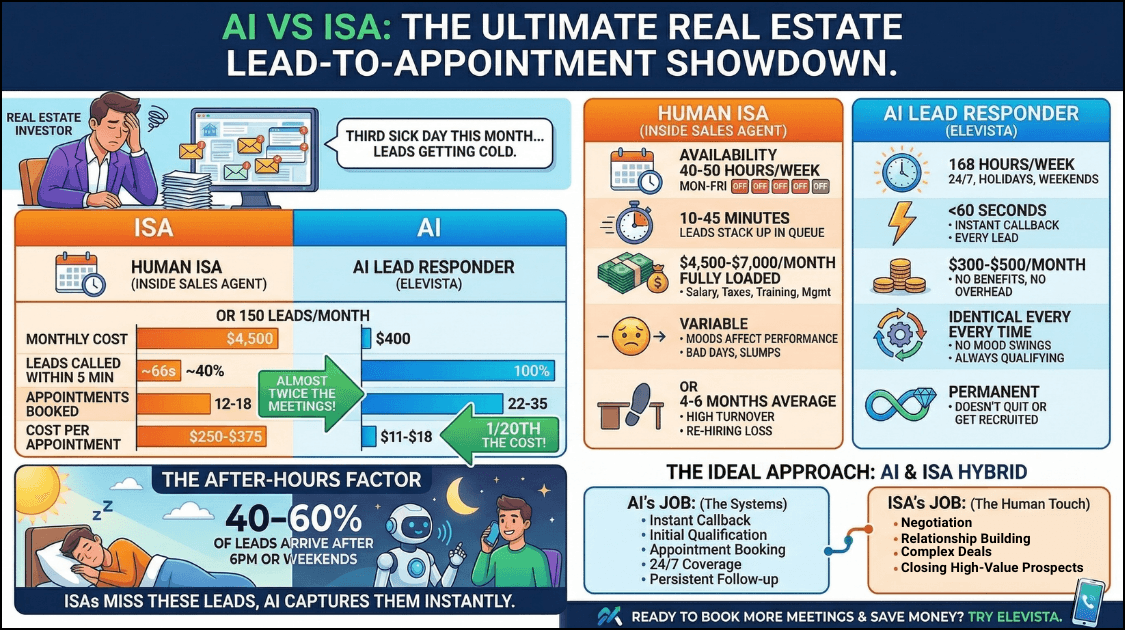
Availability: 40-50 hours a week. Your ISA works their shift, maybe 9 to 6, Monday through Friday. That gives you coverage for 45 hours out of 168 in a week. The other 123 hours? Nobody is home.
Speed: 2.1 hours on average (10-45 minutes during an active shift). Even when your ISA is working, they are not sitting idle waiting for a lead. They are mid-call with another seller, updating notes, or on a break. Leads stack up in queue and get called in order.
Cost and Consistency
Cost: $3,000-$5,000/month for a good one. That is base salary. Add payroll taxes, training time, management overhead, and the cost of replacing them every 4-6 months. According to Glassdoor salary data, your fully loaded ISA cost is closer to $4,500-$7,000/month.
Consistency: Variable. Monday morning after a great weekend? Sharp. Friday afternoon after a rough week? Flat. Humans have moods. Moods affect performance. Performance affects your pipeline.
The Retention Problem
Retention: 4-6 months average. ISA turnover in real estate is one of the industry's open secrets. You spend a month training someone. They get productive by month two. They hit their stride by month three. They start looking for a better gig by month four. By month six, you are posting the job listing again. Every time an ISA leaves, you lose a month of productivity while you train the replacement.
What Does AI Actually Deliver for Lead Calling?
Here are the same five metrics for an AI lead calling system. The contrast with ISA performance is stark across every category.
Availability and Speed
Availability: 168 hours a week. Every hour. Every day. Holidays, weekends, 3 AM. The lead that comes in during the Super Bowl gets called back the same as the one that comes in Tuesday at 10 AM.
Speed: Under 60 seconds. Every lead. No queue. No "let me finish this other call." Lead submits, phone rings. The Lead Response Management Study confirms that this kind of speed dramatically improves contact and qualification rates.
Cost and Consistency
Cost: $300-$500/month. No payroll taxes. No benefits. No training costs. No management overhead. No replacement costs because it does not quit.
Consistency: Identical every time. The 200th call of the month sounds exactly like the first. Same qualifying questions. Same tone. Same thoroughness. No bad days. No mood swings. No post-lunch slump.
Retention
Retention: Permanent. It does not quit. It does not get recruited. It does not need a raise at month six. It does not send you a two-week notice the week before your biggest marketing push.
What Do the Head-to-Head Numbers Look Like?
Running both options against the same 150 leads per month reveals a significant gap. The AI books nearly twice the meetings at a fraction of the cost per appointment, and you spend zero hours managing it.
ISA Scenario
- Monthly cost: $4,500 (fully loaded)
- Leads called within 5 minutes: ~60 (40%, only during shift hours)
- Leads called next day or later: ~60 (40%, after-hours and weekend leads)
- Appointments booked: 12-18
- Cost per appointment: $250-$375
- Your time managing the ISA: 5-8 hours/month
AI Scenario (Elevista)
- Monthly cost: $400
- Leads called within 60 seconds: 150 (100%)
- Leads called next day or later: 0 (0%)
- Appointments booked: 22-35
- Cost per appointment: $11-$18
- Your time managing the system: zero
A Real-World Example
An investor in Jacksonville was paying $4,200/month for an ISA who had been with him for five months, his longest tenure yet. The ISA was booking 14 appointments a month, which felt solid. Then the ISA gave two weeks notice. Instead of hiring a replacement, he tried Elevista. First full month: 28 appointments. His cost per booked meeting dropped from $300 to $14.
What Jobs Should ISAs Actually Be Doing?
Most investors miss the real point of the AI vs ISA debate. The question is not "which is better." It is "better at what?" ISAs are humans, and humans are better than AI at negotiation, relationship building, complex deal structuring, and reading a room during a kitchen-table conversation.
Tasks That Belong to Your ISA
- Following up with warm leads who need a second conversation
- Handling complex seller situations that require negotiation
- Building rapport with high-value prospects
- Coordinating with your acquisitions team on active deals
Tasks That Belong to AI
- Instant callback on every new lead
- Initial qualification and scoring
- Appointment booking and calendar management
- After-hours and weekend coverage
- Persistent follow-up sequences on non-responsive leads
The Best Setup Uses Both
The best operators are not choosing AI vs ISA. They are using AI for the 60-second callback and initial qualification, then handing qualified leads to their ISA for deeper conversations. The AI handles volume and speed. The human handles nuance and negotiation.
But if you are choosing one or the other? The numbers are not close.
Why Is After-Hours Coverage the Deciding Factor?
This is where the AI vs ISA comparison stops being about preference and starts being about math. After-hours leads often carry the highest motivation because sellers submit them at night when they are stressed about their situation.
The After-Hours Lead Gap
Pull your lead data. What percentage comes in after 6 PM or on weekends? Industry data from NAR suggests 40-60% of inquiries arrive outside standard business hours. Your ISA covers zero of those hours.
That means 40-60% of your leads sit untouched until your ISA clocks in the next business day. By then, those leads are 10-16 hours old. They have cooled off. They have talked to someone else. They barely remember your company name.
How AI Captures After-Hours Leads
An AI system does not have after-hours. Every lead gets called in under 60 seconds whether it is 2 PM or 2 AM. The leads your competition ignores at night become your easiest wins. For a full breakdown of the after-hours opportunity, see After-Hours Lead Capture for Real Estate.
How Do You Make the Switch from ISA to AI?
If you are currently using an ISA for lead calling and you are ready to test AI, here is a clean four-week transition that minimizes risk and lets the data speak for itself.
Week 1: Run AI Alongside Your ISA
Send all new leads to the AI system. Let your ISA focus on follow-up calls and warm leads. This gives you a direct comparison without risking lead coverage.
Week 2: Compare the Numbers
How many appointments did the AI book vs your ISA's typical numbers? What was the cost per appointment? What was the speed to first contact?
Weeks 3-4: Make the Decision and Reinvest
If the AI is outperforming (and the numbers shown above suggest it will), transition your ISA to higher-value work or reduce that expense entirely. The $3,000-$4,000/month you save on ISA costs can go straight into more leads. More leads plus faster response equals significantly more deals.
Frequently Asked Questions
How much does an ISA cost compared to AI for real estate lead calling?
A fully loaded ISA costs $4,500 to $7,000 per month when you include salary, payroll taxes, training, management, and turnover costs. AI lead calling costs $300 to $500 per month for 24/7 coverage. Cost per booked appointment drops from the $250-$375 range with an ISA to $11-$18 with AI.
Can AI really book more appointments than a human ISA?
Yes. AI calls every lead in under 60 seconds, 24/7, while an ISA only covers 40 to 50 hours per week. In head-to-head comparisons with the same lead volume, AI typically books nearly twice the appointments because it reaches leads at peak motivation instead of hours later.
Should I fire my ISA and switch to AI?
Not necessarily. The best operators use AI for instant lead callback and initial qualification, then hand qualified leads to their ISA for deeper conversations. If you must choose one, the numbers favor AI for the specific job of first-call response. But your ISA may be more valuable handling follow-up, negotiation, and relationship building.
What happens to after-hours leads with an ISA versus AI?
ISAs typically work 40 to 50 hours per week, leaving 118 to 128 hours uncovered. Industry data suggests 40 to 60 percent of leads arrive after 6 PM or on weekends. An ISA misses all of those. AI calls every lead in under 60 seconds regardless of the time, turning after-hours leads into your easiest wins.
How do I transition from an ISA to AI without losing leads?
Run AI alongside your ISA for the first week, sending all new leads to AI while your ISA focuses on follow-up. Compare appointment numbers and cost per meeting after week two. If AI outperforms, transition your ISA to higher-value work like negotiation and deal coordination.
What Is the Bottom Line on AI vs ISA for Real Estate?
The AI vs ISA debate for real estate comes down to one question: do you want to pay for someone's time, or do you want to pay for results?
An ISA gives you 45 hours a week of human effort. AI gives you 168 hours a week of instant response. One costs $4,500/month and books 14 meetings. The other costs $400/month and books 28.
Your ISA is not the problem. Asking a human to do a machine's job is the problem. Fix the structure and the results follow.
Try Elevista free and see how AI compares to your current setup →
Know investors spending $4,000+/month on ISAs who keep quitting? Join the Elevista Partner Program and earn recurring commissions every time you refer someone who's ready to stop the hiring cycle.
Frequently Asked Questions
How much does an ISA cost compared to AI for real estate lead calling?
Can AI really book more appointments than a human ISA?
Should I fire my ISA and switch to AI?
What happens to after-hours leads with an ISA versus AI?
How do I transition from an ISA to AI without losing leads?
Get insights delivered weekly
Join real estate investors who get speed-to-lead strategies and product updates every week.