AI Terms for Real Estate Investors: 12 in Plain English

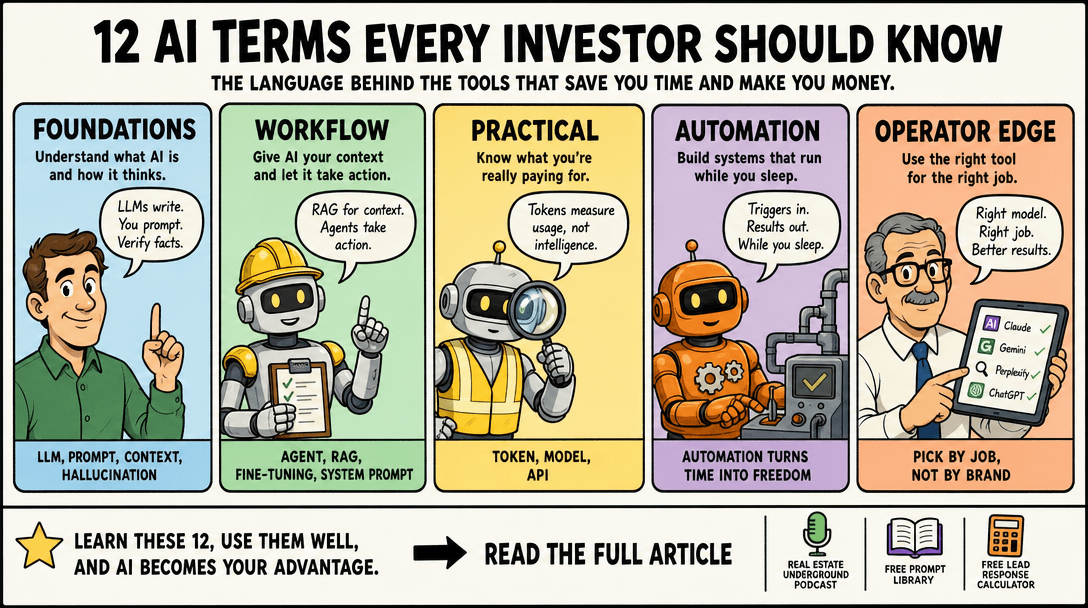
TL;DR
- You don't need to know every AI term. You need to know twelve.
- The twelve fall into three groups: Foundations (what it is), Workflow (how it works), Practical (what you pay for).
- Every term gets the definition, the real estate context, and the operator translation.
- If a vendor uses one of these words to confuse you, you'll catch it in this article.
What AI terms should real estate investors actually know?
Twelve. There are twelve AI terms that come up in real estate investing conversations often enough to matter: LLM, prompt, context window, hallucination, agent, RAG, fine-tuning, system prompt, token, model, API, and automation. Everything else is either a brand name pretending to be a term, a technical detail you don't need, or a buzzword. Learn these twelve and you can sit through any AI demo without nodding along to language you don't understand.
We use all twelve every day across Clark St Capital, Clark St Homes, and Elevista. These are the definitions we'd give you over coffee.
Foundations: what AI actually is
1. LLM (Large Language Model)
Plain English: A computer program trained on a huge amount of text that can read and write language. ChatGPT, Claude, and Gemini are LLMs.
In real estate: Every AI tool you've heard of that "writes" or "thinks" is built on an LLM under the hood.
Operator translation: When someone says "the AI," they mean an LLM. There are different LLMs, made by different companies, with different strengths. You don't need to pick one for life. You need to know which one is good at what.
2. Prompt
Plain English: What you type to the LLM. The question, the instruction, the task.
In real estate: "Write me a follow-up email to a motivated seller who hasn't responded in five days" is a prompt. So is "analyze this property at 47 Maple Street."
Operator translation: Your output is only as good as your prompt. A bad prompt gets a generic answer. A specific prompt with context gets an answer you can use. The investors who win with AI write better prompts than the ones who lose with AI. That's most of the game.
3. Context window
Plain English: The amount of information the LLM can hold in its head at once.
In real estate: If you paste a 40-page inspection report into ChatGPT and ask a question, the context window is what determines whether it can actually read the whole thing.
Operator translation: Bigger context windows mean you can dump more into the conversation. A flipper analyzing a deal might paste in MLS data, comps, the inspection report, and the contractor scope. If the context window is big enough, the LLM can reason across all of it. If it's too small, the LLM starts forgetting what you told it earlier.
4. Hallucination
Plain English: When the LLM makes something up and says it with confidence.
In real estate: You ask ChatGPT for the median sale price in Waterbury, CT. It gives you a number. The number is wrong. The LLM didn't know, but it didn't say it didn't know.
Operator translation: This is the single biggest reason investors get burned by AI. LLMs do not know when they don't know. They guess. The fix is to never use AI for facts that need to be right (comps, cap rates, case law, addresses) without a second source. Use AI for thinking, drafting, and structuring. Use a database for facts.
Speaking of getting burned by AI getting numbers wrong, we covered exactly this on the Real Estate Underground podcast recently. Worth a listen before you trust your next AI-pulled comp.
Workflow: how AI actually does the work
5. Agent
Plain English: An LLM that can take actions in the world, not just write answers.
In real estate: A chatbot answers questions. An agent answers the phone, qualifies the lead, and books the meeting. Different category.
Operator translation: When you hear "AI agent," ask what actions it can take and what triggers it. An agent that does nothing until you click a button isn't an agent. It's a chatbot with a marketing budget. Real agents run on triggers (a lead arrives, a date hits, a file lands) and do real work without you watching.
6. RAG (Retrieval-Augmented Generation)
Plain English: Giving the LLM access to a specific set of documents so it can answer questions from your stuff, not from its training data.
In real estate: You upload your buy box, your contractor list, your past deal notes, and your underwriting model into a Claude Project. Now when you ask "would I have bought this deal," it answers using your actual criteria, not generic real estate advice.
Operator translation: This is how you make a generic LLM useful for your specific business. The Operator-level setup uses RAG (Projects in Claude, Custom GPTs in ChatGPT, similar in Gemini) to give the model your context once, instead of pasting it into every prompt.
7. Fine-tuning
Plain English: Permanently retraining an LLM on your data so it speaks your language by default.
In real estate: You'd fine-tune a model if you wanted every output to sound like your firm, use your terminology, and follow your conventions without prompting.
Operator translation: You almost certainly don't need this. Fine-tuning is expensive, slow, and gets replaced by a better prompt 80% of the time. If a vendor pitches you "we fine-tuned our model for real estate," ask what they fine-tuned it on. Often the honest answer is "we wrote a long system prompt." Which is fine. Just not the same thing.
8. System prompt
Plain English: The instructions the LLM reads before every conversation, telling it who it is and how to behave.
In real estate: ChatGPT's default system prompt makes it helpful and balanced. A wholesaler's custom GPT might have a system prompt that says "You are an acquisitions assistant. Always ask about the seller's timeline before pricing. Never recommend listing with an agent. Use a New England voice."
Operator translation: The system prompt is where most of your customization happens. Investors who get great results from AI write good system prompts. Investors who get mediocre results write one-off prompts and skip the system prompt entirely.
Practical: what you're actually paying for
9. Token
Plain English: A piece of a word. AI tools count tokens to measure how much text goes in and comes out.
In real estate: A 1,000-word deal analysis is roughly 1,300 tokens. A typical motivated seller email is 200 tokens to write and 400 tokens to read.
Operator translation: When pricing pages say "$5 per million tokens," that's how much text you can process. For most investors using ChatGPT Plus or Claude Pro, you're paying a flat monthly fee and not counting tokens at all. Tokens matter when you start building automations through an API.
10. Model
Plain English: A specific version of an LLM. GPT-5, Claude Opus 4.7, Gemini 2.5 are all models.
In real estate: Different models are good at different things. One model writes faster. Another reasons better on numbers. Another is cheaper. The same company makes multiple models.
Operator translation: Don't marry one model. The Operator stack uses two or three models for different jobs. Claude for long reasoning and writing. Gemini for image work and Google integrations. Perplexity for research with citations. ChatGPT for general utility. Pick by job, not by brand loyalty.
11. API
Plain English: A way for software to talk to an LLM directly, without a human typing into a chat window.
In real estate: When a lead form on your website triggers a phone call to that lead in 37 seconds, that's an API call to an LLM. No one opened ChatGPT.
Operator translation: APIs are how AI gets baked into your business instead of sitting in a tab on your laptop. Operator-level workflows almost always run on APIs. You don't need to write code to use them. You need software that does (your CRM, your automation platform, or proprietary tools like Elevista Connect).
12. Automation
Plain English: A workflow that runs without you starting it.
In real estate: A lead hits your form at 11 PM on a Saturday. Within 37 seconds, an AI agent has called them, qualified them, and booked a meeting for Tuesday. You wake up Sunday to a calendar invite. That's automation.
Operator translation: This is the level every serious investor is moving toward. Manual AI use (typing into ChatGPT) saves time. Automated AI use (workflows that fire on triggers) gives you back your calendar. The shift from one to the other is the difference between a side tool and a real operating system.
What's missing from this list?
A lot. We left out vector databases, embeddings, MCP, multimodal, structured outputs, temperature, and about 30 other terms that show up in technical docs. None of those matter for an investor who wants to use AI well. If a vendor or a course tries to teach you those before they've taught you these twelve, that's a tell.
Save this article. When you're sitting in an AI demo and someone uses a word from this list, you'll know whether the answer they just gave you was real, or whether they were betting you wouldn't ask.
And if there's a term you've heard that we didn't cover and you want to know what it actually means, send it to us. We'll explain it the same way.
Want to put these terms to work?
The free Elevista prompt library has 30 prompts, every one of them written with these twelve terms in mind. Good prompts, good system prompts, good context. The whole library is built to make you a better Operator without learning a new vocabulary.
Also free:
- The Real Estate Underground podcast: operator-level conversations on what's working in real estate in 2026.
- Our free lead response calculator: see exactly how much money you're leaving on the table at your current speed of response.
Get insights delivered weekly
Join real estate investors who get speed-to-lead strategies and product updates every week.