How to Use AI in Real Estate: The Maturity Model

TL;DR
- Most investors are stuck at Level 1, using AI for one-off tasks and wondering why nothing compounds.
- The three levels are Hobbyist, Enthusiast, and Operator. Each is defined by behavior, not tool count.
- You can move up a level in roughly two weeks if you commit to one workflow, not ten experiments.
- Operators don't have more AI tools than Enthusiasts. They have fewer tools and more reps.
How should real estate investors actually use AI?
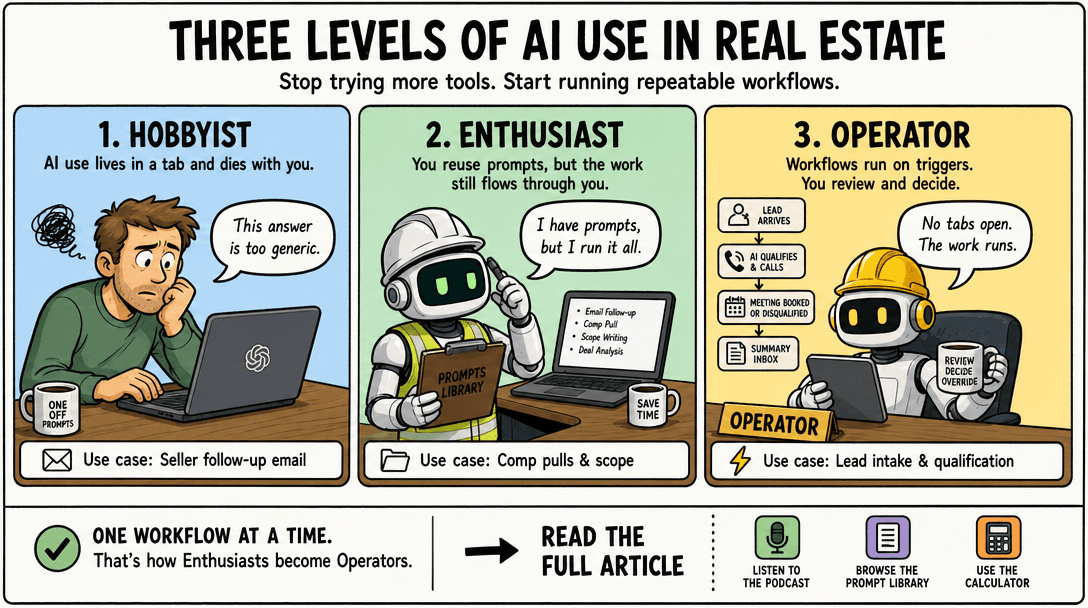
There are three levels of AI use in real estate investing: Hobbyist, Enthusiast, and Operator. Most investors think they're an Enthusiast and they're actually a Hobbyist. The difference isn't which tool you pay for. It's whether the same task runs the same way every time, and whether anyone besides you could press the button. If your AI use lives in a browser tab and dies when you close it, you're a Hobbyist. If it lives in a workflow, you're an Operator.
Clark St Capital, Clark St Homes, and Elevista all run on the same maturity ladder. We didn't get to Operator by buying more software. We got there by killing the toys.
Level 1: Hobbyist
A Hobbyist opens ChatGPT two or three times a week, types a question, copies the answer, and closes the tab. There is no system. There is no repeat use. Every prompt is written from scratch.
The Hobbyist's pattern looks like this:
- Asks AI to "write a follow-up email to a seller" with no context
- Gets back something generic that mentions "your dream home" to a guy who wants to dump an inherited property
- Sends a watered-down version
- Concludes that AI doesn't work for real estate
This is the level where most investors quit. They tried it. It was disappointing. They went back to the way they did things before.
The fix is not better tools. The fix is one repeated task. Pick the single thing you do most often, every week, and do it with AI for two weeks straight. For most wholesalers that's seller follow-up. For most flippers that's comp pulls or scope writing. Run the same prompt with the same structure on the same task for ten business days. By day three you'll start tweaking the prompt. By day ten you'll have something worth saving.
Level 2: Enthusiast
An Enthusiast has a folder, or a saved prompts list, or a Notion page. There are five to fifteen prompts in there. They get reused, mostly. The Enthusiast can show you a deal that AI helped them analyze and a seller email AI helped them write.
This is the level where things start to look real. It's also the level where most investors plateau and stay forever.
The Enthusiast's pattern looks like this:
- Uses two or three different AI tools without knowing which is best for what
- Has favorite prompts but no version control
- Can describe what AI does for them but not how the workflow runs
- Spends time inside chat windows, not inside their business
Plateau happens because the Enthusiast treats AI as a faster version of doing it themselves. The work still flows through their hands. They still write the prompt. They still read the output. They still paste the result into Gmail or a CRM. AI is a faster pen, not a smaller workload.
A good Enthusiast can save four to six hours a week. A great one can save eight. Past that, you need to change levels.
Level 3: Operator
An Operator doesn't open chat windows. The work runs.
When a lead hits the form on an Operator's site, the lead is on the phone with a qualifying agent in under 60 seconds. The qualification happens. The meeting books or the lead disqualifies. The Operator sees a summary in the morning. No prompt was written. No tab was open.
When an Operator pulls comps, the comps come back already filtered against their buy box. When they write scope, the scope arrives in their inbox with vendor pricing pre-loaded. When they review the week on Friday, the review is already drafted.
The Operator's pattern looks like this:
- Three to five tools, each doing exactly one job
- Workflows that fire on triggers (a lead arrives, a date hits, a file lands)
- Every recurring task in the business runs the same way every time
- The Operator's job is to review, decide, and override. Not to execute.
This is the level where the business stops scaling against the operator's calendar. A Hobbyist can close five deals a year. An Enthusiast can close fifteen. An Operator can close fifty without working more hours than the Enthusiast did.
The shift from Enthusiast to Operator is not about tools. It is about deciding that you will not be the bottleneck on your own work.
The 30-Second Self-Diagnostic
- How many AI tools do you pay for? 0 → Hobbyist. 4+ → probably Enthusiast. 2-3 → could be either.
- Can someone else in your business run an AI workflow without your help? No → Hobbyist or Enthusiast. Yes → Operator.
- What happens to your AI use when you close your laptop? It stops → Hobbyist or Enthusiast. It keeps running → Operator.
- When did you last write a prompt from scratch? This week → Hobbyist or Enthusiast. Can't remember → Operator.
If you got two or more answers in the Operator column, you're there. If you didn't, you know exactly which gap to close first.
Want the prompts we use across all three levels? The free Elevista prompt library has 30 prompts, organized by job, and we point out which level each one belongs to.
What's the fastest way to move up a level?
Pick one workflow. Run it the same way for two weeks.
That's it. That's the whole answer.
Most investors try to jump from Hobbyist to Operator by buying tools. It never works. You can't shortcut reps. The Hobbyist who runs the same seller follow-up workflow every Monday morning for two weeks is now an Enthusiast, with one workflow. The Enthusiast who automates the trigger so the workflow runs without them is now an Operator, with one workflow.
You don't need to be an Operator across your whole business by Friday. You need to be an Operator on one task by the end of the month. Then another. Then another. We built our internal stack across Clark St Capital and Clark St Homes one workflow at a time, over about eighteen months. The ones that stuck stayed. The ones that didn't, got cut.
The investors who win with AI in 2026 are not the ones who try the most tools. They're the ones who run the same workflow the most times.
Where does this leave you?
If you read this and saw yourself in Level 1, that's fine. Every Operator was a Hobbyist twelve months ago. The work is to pick one task and start.
If you read this and saw yourself in Level 2, the question is which workflow you'd let run without you. Not "could," but "would." Most Enthusiasts have the technical ability to automate and the emotional resistance to let go. The unlock is trust, not tooling.
If you read this and saw yourself in Level 3, you already know what comes next. You build the next workflow.
And if any of this is useful, give us a shout. We talk about this stuff for a living on the Real Estate Underground podcast.
Want to skip ahead?
If you want to see what an Operator-level deal analysis actually looks like, run a deal through our free lead response calculator. It'll show you how much money you're leaving on the table at your current speed of response and what an Operator-level workflow could change.
Also free:
- The Elevista prompt library: 30 prompts we use across acquisitions, dispo, and ops.
- The Real Estate Underground podcast: operator interviews on what's actually working in 2026.
Get insights delivered weekly
Join real estate investors who get speed-to-lead strategies and product updates every week.