Drip Campaign Alternatives That Book Real Estate Meetings

Why Do Real Estate Drip Campaigns Fail to Book Meetings?
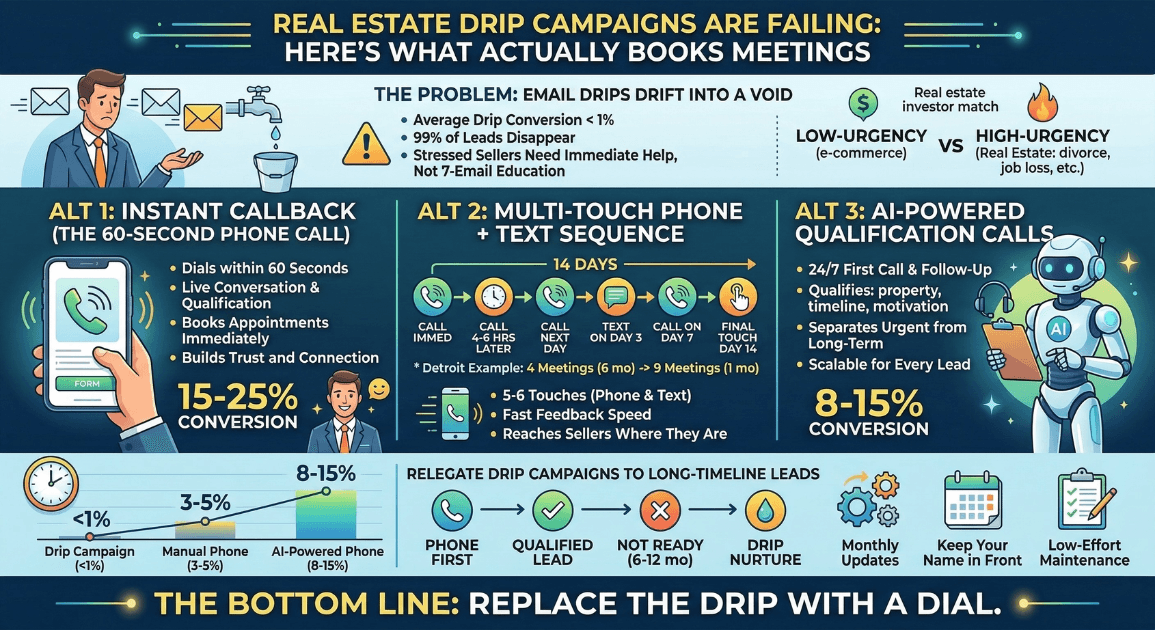
The average real estate drip campaign converts at under 1%, according to email marketing benchmarks from Mailchimp. That means for every 100 leads you feed into the sequence, 99 of them read a few emails (or more likely, didn't) and disappeared. The problem isn't your copy. It's the medium.
The Urgency Mismatch
Drip campaigns were built for a world where email was how people made decisions. A homeowner who fills out a form because they're stressed about a property doesn't need a 7-email education sequence. They need a phone call. Now. Real estate leads aren't low-urgency. A seller who fills out a "sell my house fast" form is dealing with something right now: a divorce, a job loss, an inherited property they don't want, a mortgage they can't afford.
Why Email Can't Compete With a Phone Call
Sending that person an email that says "Hi, thanks for your interest! Here's how our process works" is like handing a pamphlet to someone who just walked into the emergency room. The timing is wrong. The channel is wrong. The energy is wrong.
Here's what the numbers show. Leads contacted by phone within 60 seconds convert to appointments at 15-25%, based on research from the Lead Response Management Study. Leads who receive a drip email within 60 seconds? The conversion rate is too low to measure meaningfully.
The Timeline Problem
Drip campaigns also assume sellers will engage over time. But motivated sellers don't have time. Their situation is pressing. If they don't hear from you today, they'll hear from your competitor today. By the time your third email lands in their inbox next Tuesday, the deal is gone.
What Is the Best Instant Callback Alternative to a Drip Campaign?
The most effective real estate drip campaign alternative isn't a campaign at all. It's a single phone call that happens before the seller closes their browser tab, converting at 5-10x the rate of any email sequence.
How Instant Callback Works
When a lead fills out your form, an automated system dials them within 60 seconds. The seller's phone rings while they're still looking at the confirmation page. They pick up. A live conversation happens, qualifying the lead, understanding their situation, and booking an appointment if the fit is right.
Why It Converts So Much Better
No warming. No nurturing. No 7-email sequence. Just a phone call at the exact moment the seller is most motivated. This isn't about skipping relationship-building. It's about recognizing that the relationship starts with a conversation, not an email. A seller who talks to a real voice 30 seconds after submitting a form feels taken care of. A seller who gets an automated email feels like they entered a marketing funnel.
The Numbers
Instant callback converts to appointments at 5-10x the rate of any drip campaign, based on HubSpot's research on lead response timing. It's not a marginal improvement. It's a category change.
How Does a Multi-Touch Phone Sequence Replace Email Drip?
Some leads don't pick up the first call. That doesn't mean they need an email drip. It means they need a phone-based follow-up sequence that reaches them through channels they actually check.
The 14-Day Phone and Text Framework
Here's what replaces a 45-day email drip: a 14-day phone and text sequence with 5-6 touches. Call immediately. Call again 4-6 hours later. Call the next day. Text on day 3. Call on day 7. Final touch on day 14.
Six contacts over two weeks. Every one of them through a channel the seller actually checks: their phone. Not buried in a Gmail promotions tab between a Pottery Barn coupon and a webinar invitation.
Real Results From the Channel Switch
Research from Campaign Monitor shows average email open rates across industries hover around 20-25%, meaning most drip emails go unread. Phone-based sequences, by contrast, generate immediate feedback. A phone call tells you in 15 seconds whether the lead is interested, not ready, or unreachable. You get information faster, adjust faster, and book faster.
Why Feedback Speed Matters
The key difference between an email drip and a phone sequence is feedback speed. An email sits in an inbox for hours or days before it's opened, if it's opened. With phone follow-up, you compress weeks of passive nurturing into days of active engagement.
For a closer look at what that follow-up sequence should look like, How to Follow Up with Real Estate Leads lays out the six-touch framework in detail.
How Does AI-Powered Qualification Compare to Manual Calling?
The knock on phone-based follow-up has always been time. Calling 100 leads 6 times each is 600 phone actions a month. At 3 minutes per action, that's 30 hours of dialing, waiting, and leaving voicemails. No solo investor has that kind of time.
What AI Calling Changes
An AI system handles the entire first-call and follow-up sequence, every lead, every time, 24/7. It doesn't just call. It qualifies. It asks about the property, the timeline, the mortgage, the motivation. It separates the sellers who need a meeting from the ones who need more time.
The Scalability Advantage
This is the real estate drip campaign alternative that scales. You're not choosing between "nurture slowly with email" and "burn out calling leads manually." You're choosing a third option: automated phone conversations that do what email can't: have a dialogue, read urgency, and book appointments at the moment the seller is ready.
Conversion Rate Comparison
The difference in results is dramatic. Drip campaigns: under 1% conversion to meeting. Manual phone follow-up: 3-5% (limited by time). AI-powered phone follow-up: 8-15%, because every lead gets full coverage without human bottlenecks. Salesforce's State of Sales research confirms that automation and AI adoption correlate strongly with higher conversion rates across sales organizations.
When Do Drip Campaigns Still Make Sense for Real Estate?
Not every drip campaign should be killed. There's a narrow use case where email sequences add value, but it's not where most investors use them.
The Long-Timeline Use Case
Long-timeline leads deserve email nurture. A seller who says "I'm thinking about selling in 6-12 months" isn't ready for weekly phone calls. A monthly email that keeps your name in front of them with market updates, relevant content, a simple "still thinking about selling?", makes sense. It's low-effort, low-cost, and keeps the door open.
The Correct Order of Operations
But that's a drip for leads who've already been contacted by phone, qualified, and tagged as long-timeline. It's the last step in a system, not the first. Most investors have it backwards. They put every lead into an email drip as the first touchpoint, when email should be the maintenance channel for leads that aren't ready yet.
The Simple Hierarchy
The hierarchy is simple. Phone first. Always. Email second, only for leads the phone conversation identified as not-yet-ready. Mailchimp's email marketing data supports this: email engagement rates are highest with warm, previously-contacted audiences, not cold form submissions.
What Does the Switch From Drip to Phone-First Look Like?
Moving from a drip campaign to a phone-first system isn't complicated. Here's a four-week transition plan.
Week 1: Route New Leads to Instant Callback
Stop routing new leads into your email drip. Route them to an instant callback system instead. Every new lead gets a phone call in under 60 seconds.
Week 2: Build the Phone Follow-Up Sequence
Set up a 14-day phone + text follow-up sequence for leads who don't convert on the first call. Six touches. Phone and text only.
Week 3: Reassign Your Email Drip
Move your email drip to a long-timeline nurture role. Only leads who've been phone-qualified and tagged as 6+ months out go into the email sequence.
Week 4: Measure the Results
Compare your appointment rate from the last 30 days of phone-first against the last 90 days of email-first. The numbers will tell the story.
Elevista handles the instant callback, the qualification conversation, and the follow-up sequence automatically. You don't need to build the phone system yourself. You need to stop relying on email for a job email was never designed to do.
Frequently Asked Questions
What is the average conversion rate for real estate drip campaigns?
The average real estate drip campaign converts at under 1% to booked meetings. According to Mailchimp's email marketing benchmarks, real estate email open rates average around 20%, but click-through rates are much lower. By contrast, phone-based follow-up converts at 3-5% for manual calling and 8-15% for AI-powered systems. The gap is driven by the urgency mismatch between email's passive nature and motivated sellers' need for immediate conversation.
How many follow-up touches should I make before giving up on a lead?
Most real estate leads that convert do so between touch 4 and touch 6. The average solo investor makes only 1.5 follow-up attempts per lead, which means they're quitting right before the conversion window opens. A 14-day sequence with 5-6 phone and text touches gives every lead a fair chance to respond without the months-long timeline of an email drip.
Can I use both phone follow-up and email drip together?
Yes, but in the right order. Phone should always be the first touchpoint for new leads. Only leads that have been contacted by phone, qualified, and identified as long-timeline (6+ months) should enter an email nurture sequence. Using email drip as your first contact method wastes the urgency window that motivated sellers bring when they fill out your form.
What does an instant callback system cost compared to email marketing?
Email marketing platforms typically cost $50-$200/month, making them appear cheaper. But when you factor in the sub-1% conversion rate, the cost per appointment from email drip is extremely high (often over $500 per meeting). AI-powered instant callback systems like Elevista cost $300-$500/month but convert at 8-15x the rate, making the cost per qualified appointment dramatically lower.
How fast do I need to call a lead to beat a drip campaign?
Under 60 seconds is the target. The Lead Response Management Study found that the odds of contacting and qualifying a lead drop sharply after the first five minutes. A 60-second callback reaches the seller while they're still at their computer, still in the emotional state that prompted them to fill out the form. That timing advantage is what makes phone-first approaches convert at multiples of email-first approaches.
Try Elevista free and replace your drip campaign with instant callbacks →
Know investors still waiting for their email drip to book a meeting? Join the Elevista Partner Program and earn recurring commissions every time you refer someone who's ready to pick up the phone instead of hitting send.
Frequently Asked Questions
Why don't drip campaigns work for real estate investors?
What is the best alternative to a real estate drip campaign?
Should I completely stop using email drip campaigns?
How does AI-powered phone follow-up compare to manual calling?
How long should a phone follow-up sequence be?
Get insights delivered weekly
Join real estate investors who get speed-to-lead strategies and product updates every week.