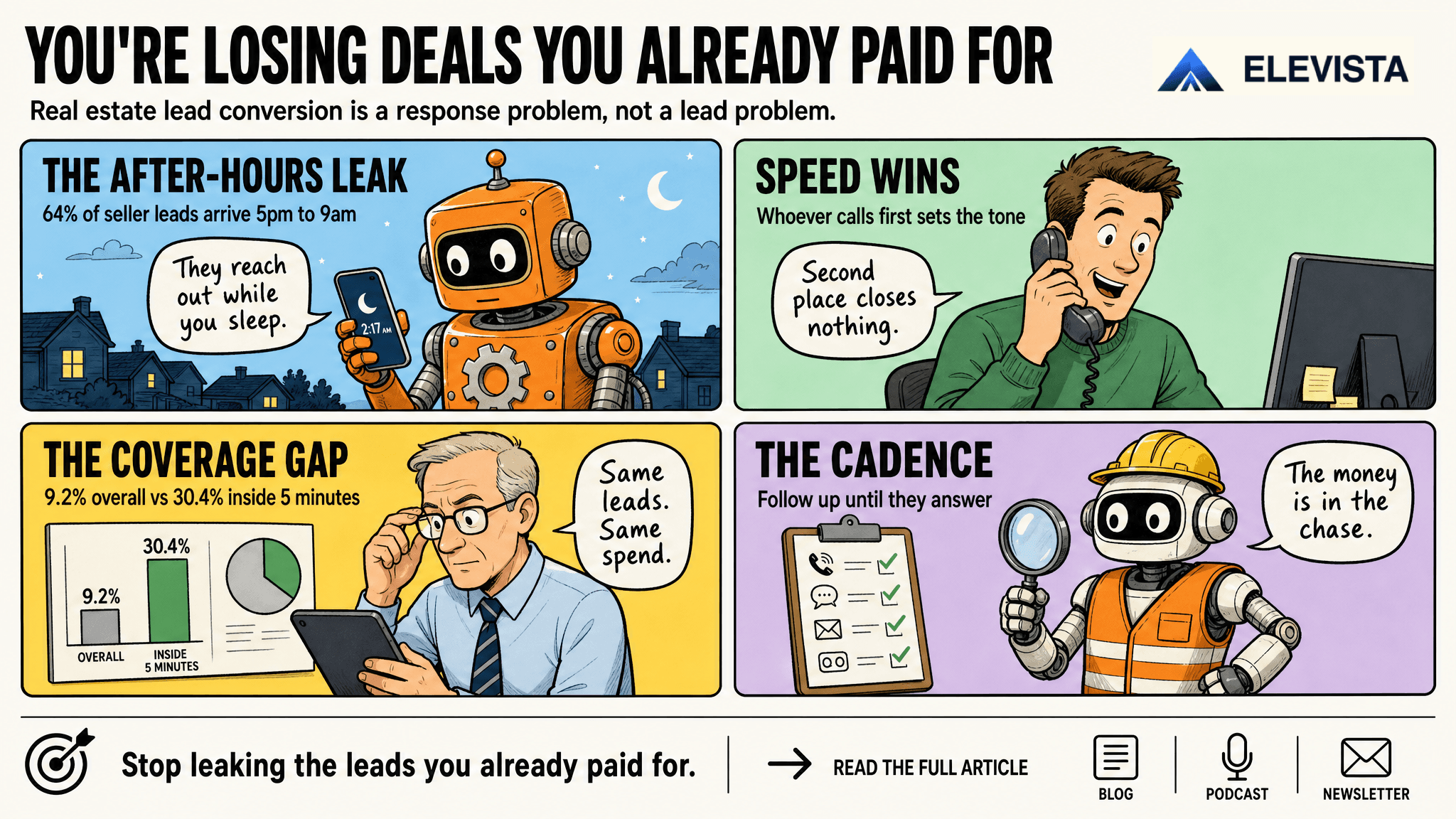
Real Estate Lead Conversion Tips That Close Deals

Why Do Most Real Estate Investors Have a Conversion Problem, Not a Lead Problem?
You're spending $3,000 a month on marketing. You're generating 100 leads. You're closing 2 deals. And you're thinking about spending $5,000 to get more leads. Stop. The leads aren't the problem.
The Math That Changes Everything
At 2% conversion, doubling your lead volume gets you from 2 deals to 4. But improving your conversion rate from 2% to 5% on the same 100 leads gets you from 2 deals to 5 without spending another dollar on marketing. According to HubSpot's sales statistics, improving conversion efficiency delivers higher ROI than increasing lead volume for most sales organizations.
Where the Real Problem Lives
Most real estate lead conversion tips focus on scripts and closing techniques. Those matter. But they're step six in a process where most investors are failing at steps one through three. If you're not converting, the problem is almost always upstream of the negotiation.
Why Is Response Speed the Most Important Conversion Factor?
Every real estate lead conversion tip in the world is irrelevant if you're slow. Speed is not one of many factors. It's the foundation everything else is built on.
What Happens After a Lead Submits a Form?
A lead fills out your form. That's the peak of their motivation. They're sitting at the computer, stressed about their property, ready to talk. Every minute that passes after submission, that motivation drops. Five minutes later, they've moved on to something else. An hour later, they barely remember your website. The next morning, you're a cold call.
The Numbers Are Brutal
The Lead Response Management Study from Dr. James Oldroyd at MIT documented the dramatic impact of response time on contact and qualification rates. Industry benchmarks show: leads contacted within 60 seconds convert to appointments at 15-25%. At 5 minutes, it's 8-12%. At 30 minutes, it's 3-5%. Next morning? You're at 1-2%.
The 10x Gap
That's not a marginal difference. That's a 10x gap between the fastest response and the average one. No script, no technique, no closing method can overcome a 12-hour response delay. If your current response time is measured in hours, fixing it to minutes will do more for your conversion rate than every other tip in this article combined. The real estate lead response time statistics make that case with hard numbers.
Why Should You Qualify Leads Before Driving to the Appointment?
Here's a conversion tip that sounds counterintuitive: turn away more leads. Most investors treat every lead like it deserves a meeting, and it costs them hours of wasted drive time every week.
The Cost of Unqualified Meetings
Someone fills out a form, you call them back, they say "sure, come by Thursday," and you drive 40 minutes to sit across from someone who wants full retail and has no urgency. That's not a converted lead. That's a wasted afternoon.
The Five Questions That Filter
Real conversion starts with qualification on the first call. Not "are you interested in selling?" That's what the form already told you. Real qualification means asking the questions that determine whether this meeting is worth your time: What's the property address? What's your timeline? Is there a mortgage? What would you need to walk away with? Are there other decision makers?
These questions do two things. They filter out the sellers who aren't ready, which saves you hours of wasted drives. And they make the meetings you do take dramatically more productive, because you already know the situation before you walk in.
Fewer Meetings, More Deals
Research from Salesforce consistently shows that top sales performers spend more time on qualification and less time on unproductive meetings. The best real estate lead conversion tips aren't about closing harder. They're about showing up to meetings you can actually close. See How to Qualify Motivated Sellers for the exact questions that do the filtering.
How Do You Build a Follow-Up System That Doesn't Depend on You?
You called. They didn't answer. You tried again the next day. Voicemail. You sent a text. Nothing. You moved on. That's 3 touches. Most real estate leads that convert do so between touch 4 and touch 6. You quit at the exact moment the data says to keep going.
The Volume Problem
This isn't a discipline problem. It's a math problem. At 100 leads a month with 6 follow-up touches each, that's 600 actions. At 3 minutes per action, that's 30 hours of follow-up every month. On top of everything else you do. Nobody can sustain that manually.
Automated Sequences vs. Manual Follow-Up
Which is why the investors who convert at the highest rates don't rely on manual follow-up. They build a sequence that runs automatically (call, wait, call again, text, call, final touch) and every lead gets the full treatment regardless of whether the investor is busy, tired, or on vacation.
The Follow-Up Gap in Numbers
The average solo investor makes 1.5 follow-up attempts per lead. Investors running automated sequences average 5-6 touches. According to HubSpot's sales follow-up research, persistence in follow-up is one of the strongest predictors of conversion success. That's not a small gap. That's the difference between converting 2% of your leads and converting 5-7%.
What Should the First Phone Call Actually Accomplish?
Most investors pick up the phone trying to get a commitment. "Can I come see the property? How about Thursday?" That's a pitch. The seller just filled out a form 30 seconds ago. They're not ready to invite a stranger to their house.
The One Job of the First Call
The first call has one job: make the seller feel heard, get the key details, and, if they're qualified, book a time to meet. That's it. You're not negotiating price. You're not explaining your process. You're not overcoming objections. You're having a 3-5 minute conversation that determines if there's a real opportunity and, if so, when to have the real conversation in person.
Three Things Top Converters Do Differently
The investors who convert first calls into appointments at the highest rates do three things differently. They listen more than they talk; the seller should be speaking 60-70% of the time. They ask questions instead of making statements: "Tell me about the property" beats "We buy houses fast." And they book the meeting during the call, not in a follow-up: "I have time Thursday at 2 or Friday at 10, which works better for you?"
Keep It Simple
Simple. Not clever. That's why it works. The National Association of Realtors' consumer surveys consistently show that sellers value responsiveness and genuine interest in their situation above all other qualities in a potential buyer.
How Do You Reduce Your Appointment No-Show Rate?
Here's a conversion leak most investors ignore: appointments that don't happen. The industry average no-show rate for real estate investor appointments is estimated at 25-35%. Fixing this is often the fastest path to more closed deals.
The Real Cost of No-Shows
At 15 appointments a month with a 30% no-show rate, that's 4-5 wasted drives. At 2.5 hours per round trip, that's 10-12 hours a month sitting in your car for nothing. Research from healthcare appointment studies shows that confirmation reminders reduce no-shows by 30-40% across industries.
Three Tactics That Cut No-Shows
Confirm 24 hours before. A text or call the day before the meeting cuts no-shows significantly. "Hi [name], just confirming our meeting tomorrow at 2 PM at [address]. Looking forward to it." Takes 30 seconds. Saves hours.
Book sooner, not later. An appointment 48 hours out has roughly double the no-show rate of one 24 hours out. If a seller is qualified and motivated, meet them tomorrow. Not next week. The longer the gap between "yes" and the doorbell, the more time doubt creeps in.
Qualify harder upfront. Sellers who've answered detailed qualifying questions (mortgage balance, timeline, price expectations) are invested in the meeting. They've already done work. They're less likely to bail than someone who said "sure, come by whenever" during a 45-second call.
Why Should You Let a System Handle the High-Volume Work?
Here's the real estate lead conversion tip that ties everything else together: you can't do all of this manually. Speed to lead under 60 seconds. Six-touch follow-up sequences on every lead. Qualification questions on the first call. Appointment confirmations 24 hours before. After-hours coverage. Weekend coverage.
The Capacity Problem
Any one of these is manageable. All of them together, at 100+ leads a month, is a full-time job on top of the full-time job of actually closing deals. Salesforce research shows that sales teams using automation for routine tasks see significantly higher conversion rates because reps spend more time on high-value activities.
Where Your Time Actually Matters
The investors who convert at the highest rates didn't get better at doing all of this. They stopped trying. They put the speed, the follow-up, and the qualification into a system that runs automatically, and they spent their time on the work the system can't do. Sitting at kitchen tables. Building relationships. Negotiating deals. Growing their operation.
The Compounding Effect
Elevista handles the first 60 seconds, the qualification, the follow-up sequence, and the appointment booking. Every lead. Every time. Day and night. You handle everything after the appointment is set, which is the work that actually requires your skills. The result isn't just better conversion. It's better conversion with fewer hours. That's the compounding effect of getting the fundamentals right.
Frequently Asked Questions
What is the single most important factor for real estate lead conversion?
Response speed. Leads contacted within 60 seconds convert to appointments at 15-25%, based on the Lead Response Management Study. No other single change in your sales process has as large an impact on conversion rates. Fixing response time from hours to seconds will outperform any improvement to your scripts, closing techniques, or marketing spend.
How many follow-up attempts should I make per lead?
Most real estate leads that convert do so between touch 4 and touch 6. A 14-day sequence with 5-6 contacts (phone calls and texts) gives every lead adequate opportunity to respond. The average solo investor makes only 1.5 attempts, quitting right before most conversions would happen. Automated follow-up systems eliminate this consistency gap.
Why do investors with fewer appointments sometimes close more deals?
Investors who qualify harder on the first call book fewer total appointments but attend more productive meetings. By filtering out sellers who want full retail, have no urgency, or aren't the decision maker, every appointment on the calendar has real closing potential. Fewer meetings, better meetings, higher conversion rate per meeting.
What should I track to improve my lead conversion rate?
Track four metrics: response time (target under 60 seconds), follow-up touches per lead (target 5-6), appointment show rate (target over 85%), and cost per closed deal. These four numbers reveal exactly where your conversion pipeline is leaking and which improvements will have the largest impact on your bottom line.
Is it better to invest in more leads or better conversion?
Better conversion almost always delivers higher ROI. Doubling your lead volume at 2% conversion gets you 4 deals for double the marketing cost. Improving conversion from 2% to 5% on the same leads gets you 5 deals for zero additional marketing spend. According to HubSpot, optimizing conversion of existing leads is more cost-effective than generating new ones for most sales organizations.
Try Elevista free and start converting more of the leads you're already paying for →
Know investors who spend thousands on leads and close a fraction of them? Join the Elevista Partner Program and earn recurring commissions every time you refer someone who's ready to stop wasting leads and start converting them.
Get insights delivered weekly
Join real estate investors who get speed-to-lead strategies and product updates every week.