Real Estate ISA vs an AI That Never Sleeps

You hired an ISA so a human would call your seller leads back before the seller calls the next investor on their list.
Good instinct. The follow-up is where deals live or die. The problem is the clock, not the human.
Let me walk through the real comparison, because "should I hire an ISA" is the wrong question. The right one is: what has to happen in the seconds after a motivated seller hits submit and who is awake to make it happen.
What a real estate ISA actually does
An inside sales agent is the person who works your inbound leads to free you up for more strategic work. In a real estate shop that means the seller fills out your form on your site or calls the number on your bandit sign and the ISA is the one who dials back, understands and qualifies the situation, figures out if there's a deal and gets a real appointment on the calendar. The acquisitions manager walks the house. The ISA gets them to the house.
Investors hire this role for a good reason. When you're checking in on other projects, in the truck, or standing in someone's kitchen, you're not answering the phone. Leads pile up. An ISA clears that pile. A good one is worth every dollar, because a lead that never gets a callback is money you lit on fire.
So this isn't a knock on ISAs. The role is real work and it matters. The question is whether one human in that seat can cover the hours where the deals actually come in. Humans call in sick. Humans go on vacation. Humans require sleep.
The gap nobody staffs
Here is the number that breaks the model.
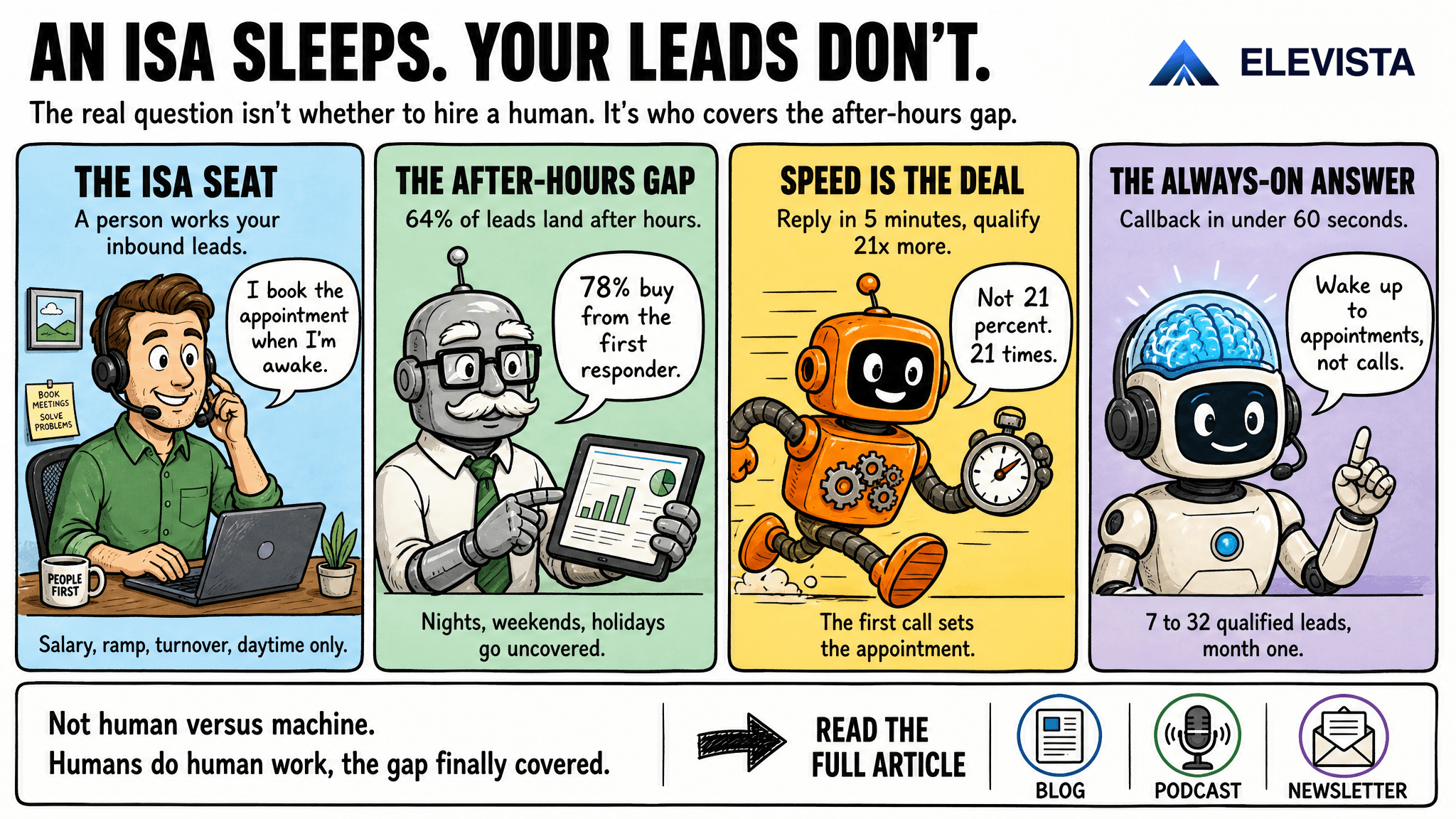
In our own flipping business, Clark St Homes, 64% of motivated-seller leads come in between 5pm and 9am. After hours. Nights, weekends, holidays the exact times your ISA is home, asleep, sick or on vacation.
Now stack that against how sellers behave. 78% of them transact with the first company that responds. A stressed-out homeowner submits their info to three or four investors at once. Whoever calls first sets the tone of the evaluation and usually locks the appointment. Everybody else is calling a seller who already said yes to someone else.
Research backs the urgency. According to the Harvard Business Review, leads contacted within five minutes are 21 times more likely to qualify than leads contacted at 30 minutes. Not 21%. 21 times.
Put it together. Most of your leads land after hours. The first responder wins. And your ISA, no matter how dedicated, requires sleep. A lead that hits your form at 9:40pm on a Saturday sits until Monday morning. By Monday the seller is under contract with the investor who picked up Saturday night and saw the property on Sunday morning.
That's not an ISA problem. It's a coverage problem. You can't solve a 24-hour gap by hiring one person to work a normal schedule.
What the seat really costs
Before you compare it to anything, run the honest cost of the human seat. There's a salary. There's a ramp, because a new ISA isn't good on day one. They learn your scripts and your market over weeks. There's turnover, because ISA is a high-churn role. When they leave, you pay for the ramp again with the next hire. And through all of it, the seat still only covers daytime hours.
So the real question isn't how to hire a better human. It's how to cover the hours a human can't work. That's a different problem and it needs a different kind of tool. Something that answers every lead the second it lands, at 2am on a holiday the same as 2pm on a Tuesday. Something that doesn't need sleep, call in sick, or take a vacation.
Here's how to think about whether that's worth paying for. A wholesale deal is worth $5k or more. A flip is worth $20k+ to low six figures. So a tool that covers the after-hours gap only has to save you one deal you'd have otherwise lost to slow follow-up and it's paid for itself many times over. Not for a month. Not for a year. Years.
One recovered deal. That's it. That's the math.
What an always-on answer actually does
This is where it stops being a straight swap for a person and turns into something different.
At our own flipping business, Clark St Homes, the tool we run for this is Elevista Connect. The moment a seller submits, it calls back in less than 60 seconds. Our qualified leads went from 7 to 32 the first month it was running, about 4 times more. It talks to the seller, walks through your script and qualifying questions and scores the lead in the background. If they're motivated and there's a deal, it books the appointment straight onto your acquisitions manager's calendar, based on her availability. If they're not ready yet, it moves them into a nurture sequence instead of letting them slip through the cracks.
So your acquisitions manager stops waking up to a list of calls to make and starts waking up to a list of appointments to keep. Same seat, different morning. The pile is already worked before anyone gets to the office.
What it does not do, so we're clear
Connect does not walk the property. It does not sit at the kitchen table, read the room and build the trust that gets a scared seller to sign. It does not negotiate the hard part of the deal. That's human work and it stays human work. If you're picturing AI replacing the relationship, that's not this and honestly that version would lose you deals.
And Connect doesn't cold call. It only talks to sellers who reached out to you first. That's by design, not a missing feature. Cold outreach keeps getting riskier under TCPA, even if you're buying, not selling. And a tool dialing strangers on your behalf puts your business on the hook for every call it makes. Inbound-only keeps you clean: every conversation Connect has starts with a seller who asked to hear from you.
Elevista Connect isn't a system you have to babysit. It's the follow-up and qualify process, the phone-tag part nobody enjoys, running on its own so your team spends their working hours on the stuff only a human can do. You're handing off the 9:40pm Saturday callback you were never going to make anyway.
That's the real comparison. Not human versus machine. Your best people are now freed up for the work only a human can do, with the after-hours gap finally covered.
Put a number on your own gap
Here's the useful part. You don't have to guess what your after-hours gap is costing you. You can measure it.
The free Lead Leak Audit looks at your own lead volume and response times and shows you, in real dollars, what those after-hours leads are quietly costing you every year. Most operators are surprised by the number, because until you see it, the leak is invisible. You never get a receipt for the deal you didn't know you missed.
Run it, look at the number and then decide for yourself what your ISA seat should be doing.
And if I can help, I'm a cheap date. Give me a shout.
Get insights delivered weekly
Join real estate investors who get speed-to-lead strategies and product updates every week.