How to Get Started With AI in Real Estate in 10 Minutes

TL;DR
- Getting started with AI in real estate takes 10 minutes, not a six-month research project.
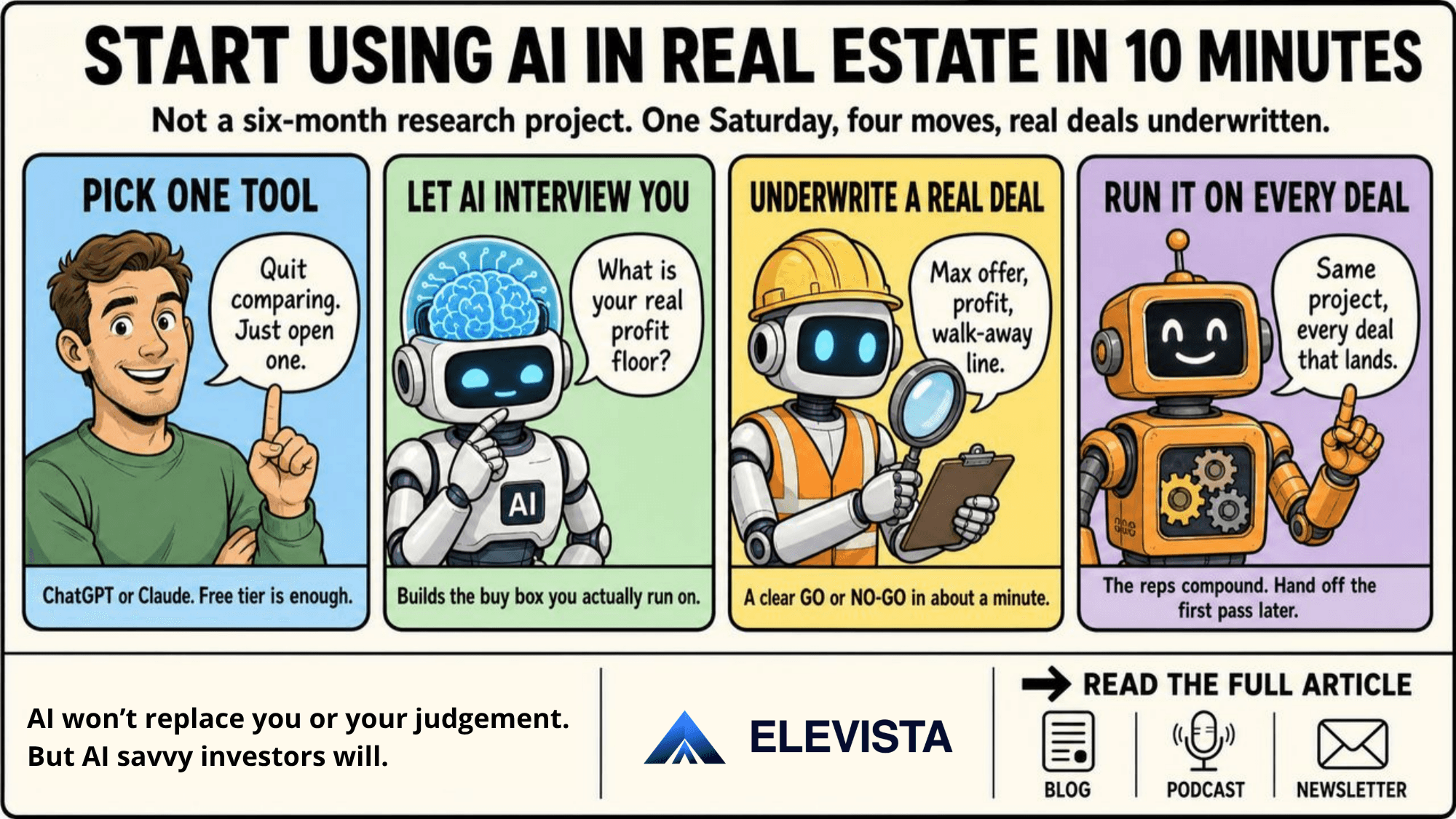
- Pick one tool, set up a project, let the AI interview you to build your buy box, then underwrite a real deal.
- The mistake is not picking the wrong tool. It is reading about AI for months and never opening one.
- The buy box you write by hand is the one you think you have. The one the AI pulls out of you in a short interview is the one you actually run on.
- Do this Saturday morning and you are ahead of most investors by Monday.
How do you actually get started with AI in real estate?
Getting started with AI in real estate takes 10 minutes. Pick one tool, ChatGPT or Claude. Set up a project for your business. Let the tool interview you to build your buy box instead of guessing at one. Then point it at a real deal and get a GO or NO-GO. That is the whole setup.
Investors ask me where to start with AI every week. The gap between thinking about AI and using AI is just one 15-minute session on Saturday morning. Most investors never close that gap. This article closes it for you, and it does it in a way that takes the guesswork out of how you buy.
Why most investors never start
The trap is never-ending research. Comparison videos, tool tier lists, YouTube AI gurus arguing over which model is best. Six months of input and zero output. You end up an expert on AI tools and that has zero impact on your business.
Picking one tool moves the needle. Any of the major tools will get you 90% of the way on day one. The remaining 10% is a deal #50 problem, not a deal #1 problem.
Fact block. The investors getting real value from AI are not the ones who picked the best tool. They are the ones who got started, picked a tool and used it on a real deal or a real task. The difference between success and frustration is reps, not the tool you pick.
Step 1: Pick one tool and stop shopping (1 minute)
ChatGPT or Claude. Both write and reason well enough to start today. Do not run a bake-off. Just pick one and open it. Don't pay for a subscription yet.
At Clark St, we run Claude for ideation, advising, operations and to build systems, but that choice came after using AI daily since 2022. On your first weekend it doesn't matter. They are both strong and there is a massive overlap on what they can do. You can't make a wrong choice here. So pick one.
If you want the full stack we run once you are past the basics, it is laid out in The 5 AI Tools We Use to Run a Real Estate Business.
Fact block. Both ChatGPT and Claude offer free tiers that handle every task in this setup. You can complete this entire article for $0. Paid plans matter once you are running daily workflows. Worry about that later. Right now, pull the trigger on one tool.
Step 2: Set up a project for your business (2 minutes)
A project in Claude, or ChatGPT, is a container that remembers your context. One-off chats forget everything the moment you close the tab. A project holds your market, your numbers, your buy box and whatever else you feed it, across every conversation.
Create a project. Name it something easy to remember. That single move separates an investor using AI as a force multiplier from an investor pasting questions into a chatbot and getting generic answers back.
Step 3: Let the AI interview you to build your buy box (3 minutes)
This is the step that does the work and it is the one almost everyone gets backwards.
The instinct is to sit down and write your buy box from scratch. Most investors can't, not cleanly. You know your market and you know a good deal when you see one, but the actual rules, your minimum spread, your real rehab ceiling, the exits you'll take and the ones you won't, are mostly in your head and have never been written down. So you write a buy box that sounds right and leaves out the constraints that actually govern what you buy. The AI then reasons off a buy box you don't really run on.
Flip it. Make the AI pull the buy box out of you. You are the one with 20 deals of pattern in your head. The tool's job is to ask the questions that get it onto the page. Paste this into your project:
I'm a real estate investor and I want you to build my buy box. Interview me one question at a time. Ask about my market and price band, my asset type, my strategy (flip, rental, wholesale), my minimum profit or spread, my max rehab tolerance, my financing, my timeline and the deal-breakers that make me walk. Ask follow-ups when an answer is vague or I'm guessing. Do not move on until each answer is specific. When you reach 95% confidence you can deliver successfully on this task, write my buy box as a tight one-paragraph spec I can reuse, and list anything I was fuzzy on that I should pin down before I make offers.
Then, answer honestly, including the parts you're not sure about. The fuzzy answers are the point. When you find yourself typing "I guess around 65%" or "depends on the street," that is the AI finding a number you've been running on feel instead of a rule. Here is what a good interview surfaces:
AI: What's your minimum profit on a flip, in dollars, after all costs? You: I don't know, 40 or 50K? AI: Those are different deals. At a 40K floor you take a marginal rehab you'd pass on at 50K. Which one would actually make you sign? You: 50K. Under that it's not worth the risk and the months. AI: Got it. 50K net floor. Does that hold on a heavier rehab, or does your floor go up when the scope gets bigger?
That exchange is the whole lesson. You walked in with a range. You walked out with a number and a rule about when the number moves. That is guesswork leaving your business. The AI didn't know your floor. It got it out of you by refusing to accept the vague answer, which is exactly what a good partner does and exactly what a blank text box never will.
When the interview is done you get back something like this, written by the tool from your answers:
Connecticut single-family, New Haven and Hartford counties. 3 bed, 2 bath minimum. ARV under $400K. Max offer at 70% of ARV minus rehab. Rehab ceiling $60K, and net profit floor of $50K that rises to $65K when rehab clears $40K. Exit by resale within 6 months. Walk if the comps are thin or the foundation or roof is in scope.
Then ask the tool one more thing: "Turn this buy box into a system-instructions prompt I can paste into my project's custom instructions." It will hand you back a clean block of standing instructions. That block is what you carry into the next step.
Fact block. A buy box you write by hand captures what you think your rules are. A buy box the AI interviews out of you captures the rules you actually run on, including the constraints you've never written down. That gap is where bad offers come from. Closing it is the cheapest accuracy upgrade in your business.
Want to hear how operators use context to run their whole business? Ed walks through specific AI workflows with working investors on the Real Estate Underground podcast.
Step 4: Make the buy box standing context (1 minute)
A buy box sitting in one chat is a one-off. The next conversation forgets it and you're back to re-pasting it every time you open the tool.
Take the system-instructions prompt Step 3 produced and paste it into your project's custom instructions, the settings field Claude and ChatGPT both give you for standing context. Now it loads into every conversation in that project automatically. You build it once and the tool reasons inside your real constraints from here on, not a national average and not a buy box you wrote to sound disciplined. Guessing and ambiguity squashed.
Step 5: Underwrite a real deal (3 minutes)
Now give it a real deal. Pull up a property you are actually looking at. With your buy box now running as standing context, paste this:
Act as a conservative fix-and-flip underwriter. Use my buy box. Here's a deal I'm looking at:
- Town: [ ]
- ARV (my comps): $[ ]
- Estimated rehab: $[ ]
- Asking price: $[ ]
Add a 10% minimum contingency to my rehab number. Assume my ARV is optimistic until proven otherwise. Tell me:
- My Maximum Allowable Offer using the 70% rule: (ARV x 0.70) minus rehab.
- Projected net profit at the asking price after rehab, a 6-month hold, 5% commission and standard closing costs. Label anything you assume.
- A clear GO or NO-GO against my buy box: does this clear my profit floor AND come in at or under my max offer?
- The one number most likely to kill this deal.
Be direct. Numbers over adjectives. If it's a bad deal, say so.
Fill the four blanks with a deal on your desk right now. In about a minute you get back a maximum allowable offer, a projected profit number, a straight GO or NO-GO measured against the floor you set in Step 3, and the single number most likely to sink the deal.
Now you're using AI to help with underwriting. It is the work a new investor pays a mentor to check, or worse, gets wrong by gut and finds out about at the closing table. You just did it in the time it takes to read the listing. Save the output. That is your offer number and your walk-away line for that property.
Fact block. Every flip project should carry a 10% minimum rehab contingency. Demo opens walls, walls hide surprises, and the surprise is never cheaper than you hoped. The prompt builds that 10% in before it runs the math, so the GO or NO-GO you get back already survives a rehab number that comes in heavy. It will not talk you into a deal that misses your own rules.
That prompt is the seed of the full underwriting engine we run at Clark St on every deal: max offer, counter offer ladder, rehab sanity check, resale-market cross-check, the works. The 30 we use, each with the reasoning behind it, are in the Elevista prompt library.
Step 6: Run it on every deal this week
The setup is worthless if Saturday is the only time you ever do it. The compounding is in the reps.
Now use this project for every deal that crosses your desk over the next week. The point is that the project, the buy box and the habit are already built. Next week you start at Step 5.
The math that matters
The setup costs 10 minutes: one minute to pick a tool, two to build the project, three to let the AI interview you into a real buy box, one to turn that into standing context, three to underwrite your first deal.
You now have a buy box that holds the rules you actually run on, not the ones you assumed. Every property you look at from now on gets a maximum allowable offer, a profit projection and a go/no-go in about a minute, scored against that buy box instead of your gut. That is the difference between making offers you can defend and making offers you hope work out. The setup pays for itself the first time it talks you out of a deal that missed your floor by 8K you'd have talked yourself into in the past. And once you have tweaked it to the point where it produces consistent results, you can hand this to someone who works for you to do the first pass, instead.
By the time you finish your second cup of coffee on Saturday morning, you have a project built, a buy box the AI pulled out of your own head and one deal underwritten. That puts you ahead of the investor still watching comparison videos and ahead of the one who has read about AI for six months without opening it.
You didn't need to be early on AI. AI isn't going to replace you or your judgment. You simply need to figure out how to use AI to systematize your business so you don't lose to competitors who already have this stuff figured out. Ten minutes this weekend is how you begin to avoid losing to more AI-savvy competitors.
Get the 30 prompts we use. Congrats. You just built v1.0 of a buy box and underwrote a deal. Welcome to the AI game. Now you can create projects that will draft your seller outreach, clean a lead list or analyze comps. Build those projects the exact same way we did here. The Elevista prompt library has 30 prompts, each with the "why this works" reasoning, built for the exact tasks investors run every week. Free.
Also free:
- Elevista deal calculator for MAO, ARV-based offer math and rehab modeling in under two minutes.
- Real Estate Underground podcast for operator-level conversations on running a real estate business in 2026.
Get insights delivered weekly
Join real estate investors who get speed-to-lead strategies and product updates every week.