Real Estate VA vs AI: Which Books More Meetings?

Why Are You Choosing Between a VA and AI for Lead Follow-Up?
Your leads are piling up. You are missing calls. You need help, so you start looking at two options: hire a virtual assistant or use an AI system. Both promise to call your leads, book appointments, and free up your time. But one of them sleeps, takes lunch breaks, and quits after three months.
The real estate virtual assistant vs AI debate is not about which technology is cooler. It is about which one actually puts meetings on your calendar consistently, 24 hours a day, without you babysitting it. The same trade-offs show up in the head-to-head AI vs. ISA comparison, but VAs add their own cost and skill-level wrinkles worth isolating.
What This Comparison Covers
This article breaks down the VA and AI options using real numbers: cost, availability, speed, quality, and retention. No marketing fluff, just the metrics that affect your bottom line.
The Core Trade-Off
A VA gives you hours. AI gives you results. The question is which one aligns with how your leads actually behave, especially the 40-60% that arrive when no human is available to answer.
What Does a Real Estate Virtual Assistant Actually Deliver?
A good VA can handle admin work: updating your CRM, pulling comps, managing your calendar, and sending follow-up emails. That stuff is valuable. But when it comes to calling leads and booking appointments, the VA model has measurable limitations.
Cost and Hours
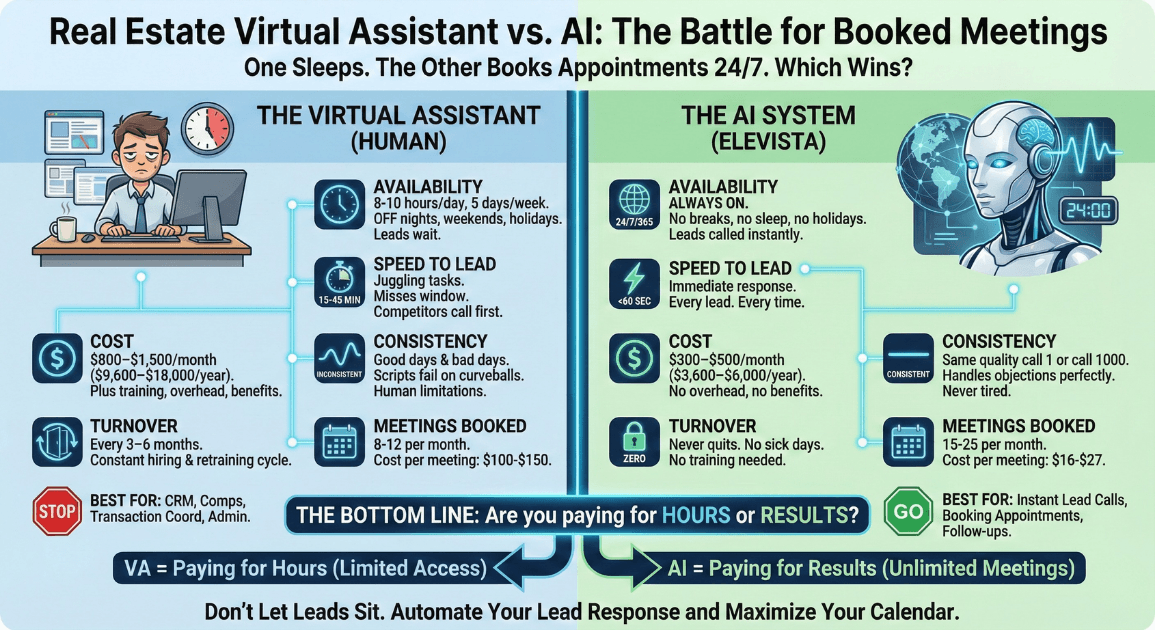
Cost: $800 to $1,500/month for a dedicated lead caller. That is $9,600 to $18,000 a year before you factor in training time, management overhead, and turnover costs. According to salary data from Indeed, real estate VAs with lead-calling experience command the higher end of that range.
Hours: 8 to 10 per day, 5 days a week. Your VA works when they are scheduled. Leads that come in at 10 PM on a Tuesday sit until morning. Leads that come in Saturday afternoon wait until Monday. That is 128 hours a week where nobody is answering.
Speed and Quality
Speed: 15 to 45 minutes on average. Even during working hours, your VA is juggling multiple tasks. They are updating records, making other calls, and taking breaks. The lead that came in at 2:13 PM might not get called until 2:45 PM. Research from the Lead Response Management Study shows that even a 30-minute delay cuts conversion rates significantly.
Quality: Inconsistent. Your VA has good days and bad days. They follow a script, but when a seller throws a curveball ("Well, my ex-husband is on the title and he lives in another state"), the script does not cover that. They either freeze up or give a vague answer that kills the seller's confidence.
The Turnover Problem
Turnover: Every 3 to 6 months. This is the part nobody talks about. VA turnover in real estate is brutal. You spend 2-3 weeks training someone. They get decent after a month. They quit after three months. Now you are back to square one, leads piling up while you train the replacement.
None of this means VAs are bad. It means they are human. And humans have limitations that directly impact your bottom line.
What Does AI Actually Deliver for Lead Calling?
Here are the same five metrics for an AI lead calling system. The differences are most pronounced in availability, speed, and retention, the three areas where human limitations hit hardest.
Cost and Hours
Cost: $300 to $500/month for unlimited calls. No overtime. No benefits. No management overhead. That is $3,600 to $6,000 a year, roughly a third of what a VA costs.
Hours: 24/7/365. The lead that comes in at 10 PM gets called at 10:01 PM. The lead that comes in on Christmas morning gets called on Christmas morning. There are no off-hours. There is no coverage gap.
Speed and Quality
Speed: Under 60 seconds. Every lead. Every time. No exceptions. No "I was on another call" or "I was at lunch." The system does not have a lunch break.
Quality: Consistent. The 50th call of the day sounds exactly like the first. It asks the right qualifying questions every time. It handles curveballs because it has been trained on thousands of real seller conversations. It does not get tired, frustrated, or distracted.
Retention
Turnover: Zero. It does not quit. It does not call in sick. It does not need a two-week vacation. It does not ghost you after three months because they found a better gig.
What Do the Numbers Say About Meetings Booked Per Dollar?
Forget the feature comparison for a second. Here is what matters: meetings booked per dollar spent. The gap between VA and AI performance becomes clear when you run the same leads through both models.
VA Scenario
- Cost: $1,200/month
- Hours available: 40 hours/week
- Leads called per month: ~200
- Average speed to lead: 30 minutes
- Meetings booked per month: 8-12
- Cost per meeting: $100-$150
AI Scenario (Elevista)
- Cost: $400/month
- Hours available: 168 hours/week
- Leads called per month: unlimited
- Average speed to lead: 60 seconds
- Meetings booked per month: 15-25
- Cost per meeting: $16-$27
A Real-World Comparison
Same leads. Same market. The AI books twice the meetings at a fifth of the cost per meeting.
One investor in Houston was spending $1,400/month on two part-time VAs for lead calls. They were booking about 10 appointments a month combined. He switched to Elevista. First month: 22 appointments. His cost per booked meeting dropped from $140 to $18.
For the full side-by-side breakdown of what AI costs versus a dedicated human caller, see AI vs. ISA for Real Estate.
Where Do VAs Still Win (And Where Do They Fall Short)?
This is not a "fire your VA" article. VAs are great for things AI should not be doing. The key is matching each resource to the tasks where they perform best.
Tasks Your VA Should Handle
- CRM management and data entry
- Pulling comps and running property research
- Coordinating with title companies and buyers
- Managing your transaction pipeline
- Administrative follow-up after meetings
Tasks AI Should Handle
- Instant lead callback (the speed game)
- After-hours and weekend lead response
- Initial qualification and scoring
- Appointment booking and calendar management
- Persistent follow-up sequences
The Smartest Setup Uses Both
The smartest operators are not choosing one or the other. They are using AI for the thing it does best (responding instantly and booking meetings) and keeping their VA focused on the work that requires a human brain.
Your VA should not be a phone jockey. They should be a transaction coordinator. Let the AI handle the calls. Let the human handle the deals.
How Many Meetings Are You Missing Because Nobody Answered?
Here is the real question in the real estate virtual assistant vs AI debate: how many meetings are you losing right now because nobody picked up the phone? The answer, for most investors, is uncomfortable.
The After-Hours Lead Gap
Pull your CRM data from last month. Look at every lead that came in after 6 PM or on a weekend. How many got called back within 5 minutes? How many got called back at all?
According to NAR research, a significant portion of real estate inquiries arrive outside standard business hours. If you are relying on a VA who works 9-to-5, those leads are sitting untouched for 12-15 hours minimum.
The Dollar Cost of Unanswered Leads
At $40-$80 per lead, that is not just an inconvenience. That is thousands of dollars a month in leads that never got a conversation. Every unanswered after-hours lead is marketing spend with zero return.
How Should You Decide Between a VA and AI?
The right choice depends on your lead flow, budget, and how much time you want to spend managing people. Here is a straightforward decision framework.
Choose a VA If
- You get 5+ leads a week and they all come in during business hours
- You have time to train and manage someone
- You are comfortable with 15-45 minute response times
- Your budget allows $1,200+/month for lead calling alone
Choose AI If
- You need every lead called back in under 60 seconds
- A significant portion of your leads come in after hours
- You do not want to manage, train, or replace anyone
- You want lower cost per booked meeting
- You want consistent quality on every single call
Choose Both If
- You are scaling and need AI for speed plus a VA for admin
- You want the AI handling calls while the VA handles everything else
Frequently Asked Questions
How much does a real estate VA cost compared to AI for lead calling?
A dedicated lead-calling VA costs $800 to $1,500 per month ($9,600 to $18,000 per year) before training and turnover costs. AI lead calling costs $300 to $500 per month for 24/7 coverage. Cost per booked meeting drops from $100-$150 with a VA to $16-$27 with AI.
Can AI really book more meetings than a virtual assistant?
Yes. AI calls every lead in under 60 seconds, 24/7, while a VA only covers 40 to 50 hours per week. With the same lead volume, AI typically books twice as many meetings because it reaches sellers at peak motivation instead of 15 to 45 minutes later.
Should I fire my VA and replace them with AI?
Not necessarily. VAs are great for CRM management, pulling comps, coordinating with title companies, and managing your transaction pipeline. The smartest operators use AI for instant lead callback and appointment booking, then keep their VA focused on admin and deal coordination work that requires a human brain.
What percentage of leads come in after hours when my VA is not working?
Industry data suggests 40 to 60 percent of real estate leads arrive after 6 PM or on weekends. If your VA works 9-to-5, those leads sit untouched for 12 to 15 hours minimum. At $40 to $80 per lead, that represents thousands of dollars per month in leads that never get a conversation.
How do I decide between hiring a VA or using AI for lead response?
Choose a VA if all your leads arrive during business hours and you have time to manage someone. Choose AI if you need every lead called in under 60 seconds, your leads arrive after hours, and you want lower cost per meeting with zero management. Choose both if you are scaling and want AI for speed plus a VA for admin.
What Is the Bottom Line on Virtual Assistant vs AI?
The real estate virtual assistant vs AI question comes down to one thing: are you paying for hours or are you paying for results?
A VA gives you hours. They will work their shift and do what they can in that window. An AI gives you results: every lead called, every time, regardless of when it comes in.
You do not need someone sitting by the phone. You need meetings on your calendar. Focus on what actually gets you there.
Try Elevista free and see how many meetings AI books vs your current setup →
Know investors still hiring VAs just to make phone calls? Join the Elevista Partner Program and earn recurring commissions every time you refer someone who's ready to stop overpaying for lead response.
Frequently Asked Questions
How much does a real estate VA cost compared to AI for lead calling?
Can AI really book more meetings than a virtual assistant?
Should I fire my VA and replace them with AI?
What percentage of leads come in after hours when my VA is not working?
How do I decide between hiring a VA or using AI for lead response?
Get insights delivered weekly
Join real estate investors who get speed-to-lead strategies and product updates every week.