Systemize Your Flipping Business in 30 Minutes, One Process at a Time

TL;DR
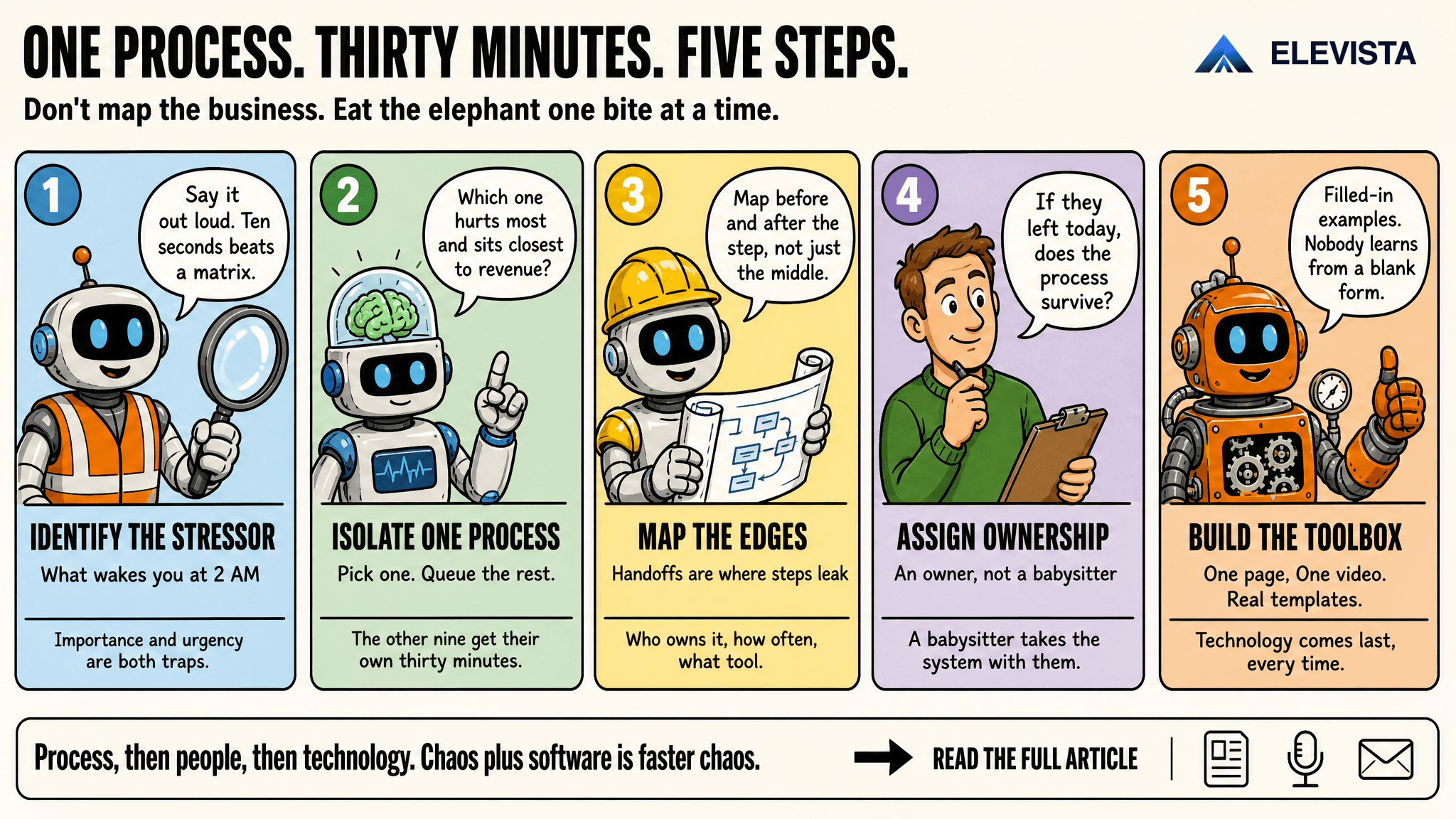
- Don't map the entire business. Eat the elephant one bite at a time. Pick the one process causing the most brain damage that also sits closest to revenue.
- Ten seconds of honesty beats a scoring matrix. You already know what it is.
- Write the steps down, including what happens before the step and after it. The middle is not where deals leak.
- Put a name on it. An owner, not a babysitter. If the process dies when they leave, you never delegated.
- Build the toolbox: a one page SOP, a three to five minute video, and filled-in templates and tools. Technology comes last.
To systemize a flipping business, you don't map the whole operation. Remember how to eat an elephant? One bite at a time.
So you pick the one process causing you the most stress (I call it brain damage). Pick one that also touches revenue. Isolate that single activity. Write down every step including the handoffs before and after it. Assign one person to own that process and its outcome instead of the tasks. Then, build a toolbox around it.
Spend thirty minutes per process. The time it hands back is what funds the next one.
I wrote recently about the difference between using AI and owning a system that runs without you. That piece was the diagnosis. This one is the method.
More deals is not more money
There's a point where volume starts working against you. Mine was three simultaneous deals. Past that number I wasn't running deals. I was chasing. Details began to get missed. Mistakes happened. Balls got dropped. I stopped searching for new deals because I was too busy with the existing projects.
So I did what everybody does. I hired a team.
Here's what hiring into an undefined process buys you. You become a babysitter.
You spend your day answering questions that only exist because nobody wrote anything down. No one was trained on your way to do it. No one took ownership to do it the right way, every time. Your time and your margin pays for that gap, quietly, every month.
The good news, I learned you don't need an army. You just need a machine.
Why the standard advice never gets finished
You've been told to map your entire business. Draw the flowchart. A thirty-two step framework. Endless whiteboard sessions. Work instructions detailed enough that a stranger off the street could follow them.
That advice isn't wrong. As Nick Huber said on our podcast, the job is to create a system that an average person can successfully run.
You've got a closing Thursday, a roofer who didn't show up Monday and an inspector who wants to talk about the electrical panel.
You're not writing a twenty page SOP document this quarter and we both know it. So don't.
Pick one that stresses you out. Pick one close to your revenue or profitability. Block off thirty minutes on your calendar. Pick the one you'll finish today. That's it.
Step 1: Identify the stressor
The filter is two things. What stresses you out and how close does it sit to your revenue or profitability.
Not what feels most important or urgent. Not what's easiest to fix. What's causing you brain damage and touching your money at the same time.
I rank by brain damage on purpose, because importance and urgency are traps. The important thing is usually the thing you feel responsible for fixing. The urgent one is the gator biting you in the backside.
The process causing brain damage is the one that wakes you up at 2 AM. Those are rarely the same and only one of them will actually get done on a Tuesday afternoon.
Now, you're going to want to score this. Rank ten candidates, weight them, build a matrix. Don't do it.
A thirty step scoring model is procrastination wearing a spreadsheet.
Step 2: Isolate one process
Here's my candidate list.
- Weekly deal flow
- Contacting tax liens
- Contacting code violations
- Contacting pre-foreclosures/foreclosures
- Search Engine/Answer Engine/Generative Engine Optimization management
- Sending direct mail
- Instant follow-up on inbound leads
- Same day offer letters
- Funding
- Content creation (for awareness, credibility and trust)
- Investor outreach
- Investor communications
Ten real things and you probably recognized two or three of your own in there.
What had you staring at the ceiling at 2 AM some night this past week?
Say it out loud right now. Whatever just came out of your mouth is the right answer. Start there.
For me, it was same day offers.
Turnaround speed is what wins competitive deals. The seller who gets a real number today remembers who moved first.
The other nine weren't abandoned. They were queued. Next week the next one gets its own thirty minutes.
Today we begin with one.
Step 3: Map the steps, including the edges
Same day offers, start to finish, is ten steps.
- Walk the property and interview the owner (i.e. what's important to them?).
- Identify the renovation tasks.
- Price out the reno budget.
- Run comps for ARV.
- Calculate the maximum offer (best & final).
- Create our offer letter with P&S.
- Review, finalize and send it.
- Confirm receipt.
- Get seller feedback.
- Close the deal or walk away.
Read fast, that looks obvious. It isn't. Three of those break in real life and they all break the same way, at a handoff.
Pricing the reno is you sitting down with a spreadsheet.
- Do you have data from your past projects?
- Do you have basic costing for a materials list?
- Do you price a renovation by size (small, medium, large), by line item or by square footage?
- Do you know what your contractors charge per hour?
Confirming receipt is nobody's job, so nobody checks and a deal dies in a spam folder.
Getting seller feedback is where the process leaves the map entirely because nobody wrote down what happens after the offer goes out.
So for every step, name three things:
- Who owns it?
- How often does it run?
- What tool manages it?
Then do the part almost everyone skips. Map what happens before the process and after it, not just the middle. The middle is the part that gets documented, because the middle is the part you probably do yourself. The before and after are the handoffs and handoffs are where steps leak.
Until those steps are written down, you're just winging it.
Step 4: Assign ownership, not tasks
Here's the test. If this process owner left today, does the process survive? Could someone else step in and understand what needs to be done?
A babysitter runs the process. Everybody's alive when you get home but nothing is better than when you left. When a babysitter quits, the system walks out with them because it lived in their head.
An owner runs the process, absorbs the mistakes, makes it better and hands it back better than they found it.
The same human can be either a babysitter or an owner. This isn't about who you hired. It's about how you assigned the work.
I got this wrong for years. I've done 75+ flips and for a long stretch of that I had help. Virtual assistants, a GC, people doing plenty of the work. I still owned every outcome because I'd handed out tasks but I kept control. Everything lived in my head. I had babysitters. I didn't have owners.
A documented process with a human owner is operational leverage. Without it, every time you go on vacation, the business stops. You never get a break because nothing can operate without you.
If it's only you right now, this still applies. Every step lives in your head, so you're winging it. There's nothing to put on your calendar because everything is a one-off, when you remember to do it.
And if you're being honest with yourself, how many balls do you drop during the week?
Be honest.
Your first hire means downloading your head into somebody else's brain. If you're winging it, you'll probably delay the hire because documenting and teaching someone else is painful. Even if you do bite the bullet and hire someone, it'll take months to get them up to speed.
Ask me how I know.
Build the architecture now. It will help you become more disciplined on the things that need to get done on a weekly basis.
- You will stop dropping balls.
- You will stop making mistakes.
- You will stop feeling overwhelmed.
- You will stop waking up at 2 AM.
When it comes time to hire, that person takes the keys to something that already runs.
Same goes for software. You can't hand over a process that exists only in your head. There's nothing real to automate.
Slow down, take 30 minutes and use this framework to think it through.
Step 5: Build the toolbox
One place. Your source of truth. Three things in it.
A one page SOP. One page. If it won't fit on a page, either the process is too big or you don't understand it well enough yet. Go back to step two and cut it in half.
A video. Three to five minutes of you screen recording yourself doing the work one time, talking the viewer through it while you do it.
Templates and tools. Use real world examples.
- The email
- The offer letter
- The P&S agreement
- The phone script when you follow up to confirm receipt
- The typical 3-5 objections and how you want them answered
Use filled-in examples, not blank forms. Nobody learns anything from a blank form.
Your first process mapping may take a little longer than 30 minutes. It usually does. By the third one it's a 15-minute exercise.
Why the technology comes last
Investors buy software hoping it fixes the business. You don't want to, nor can you, automate a broken (or non-existent) process.
There's a stack and it only works bottom to top.
- Process, meaning documented actions.
- People, meaning defined tasks and roles.
- Technology, which is the force multiplier.
If the first two layers are chaos, you didn't buy a fix. You bought faster chaos and you wasted your money.
Do this today
- Set a thirty minute timer.
- Name the process that stresses you out the most.
- Write down the steps as well as its inputs and outputs (one page only).
- Point to the human being who owns it (you or a team member).
- Create a three minute video that records how you currently do it.
- Collect the templates and tools you use right now to do this job. Put them all in one place where someone on your team (or you) can find them (we use Google Drive).
Then run the math on what you get back.
- How many times did you run this process last month?
- How many times did you drop the ball because you get overwhelmed? And this process is delayed.
- How much did a delay or a missed deadline cost you when you lost credibility with a seller and you didn't get the deal?
That's not the payoff. That's the funding. Those costs are what pay for the next process.
Once you understand the process, you've documented it, you know who owns it and you understand the payoff for executing it, then and only then is it time to invest in technology.
If you're waiting for a quiet week to do this. Stop it. The quiet week isn't coming.
There's always a closing, always a roofer, always an inspector.
Put thirty minutes on your calendar and take the first bite of your process elephant.
And if I can help, give me a shout.
Get insights delivered weekly
Join real estate investors who get speed-to-lead strategies and product updates every week.