Using AI vs Owning a System That Runs Without You

TL;DR
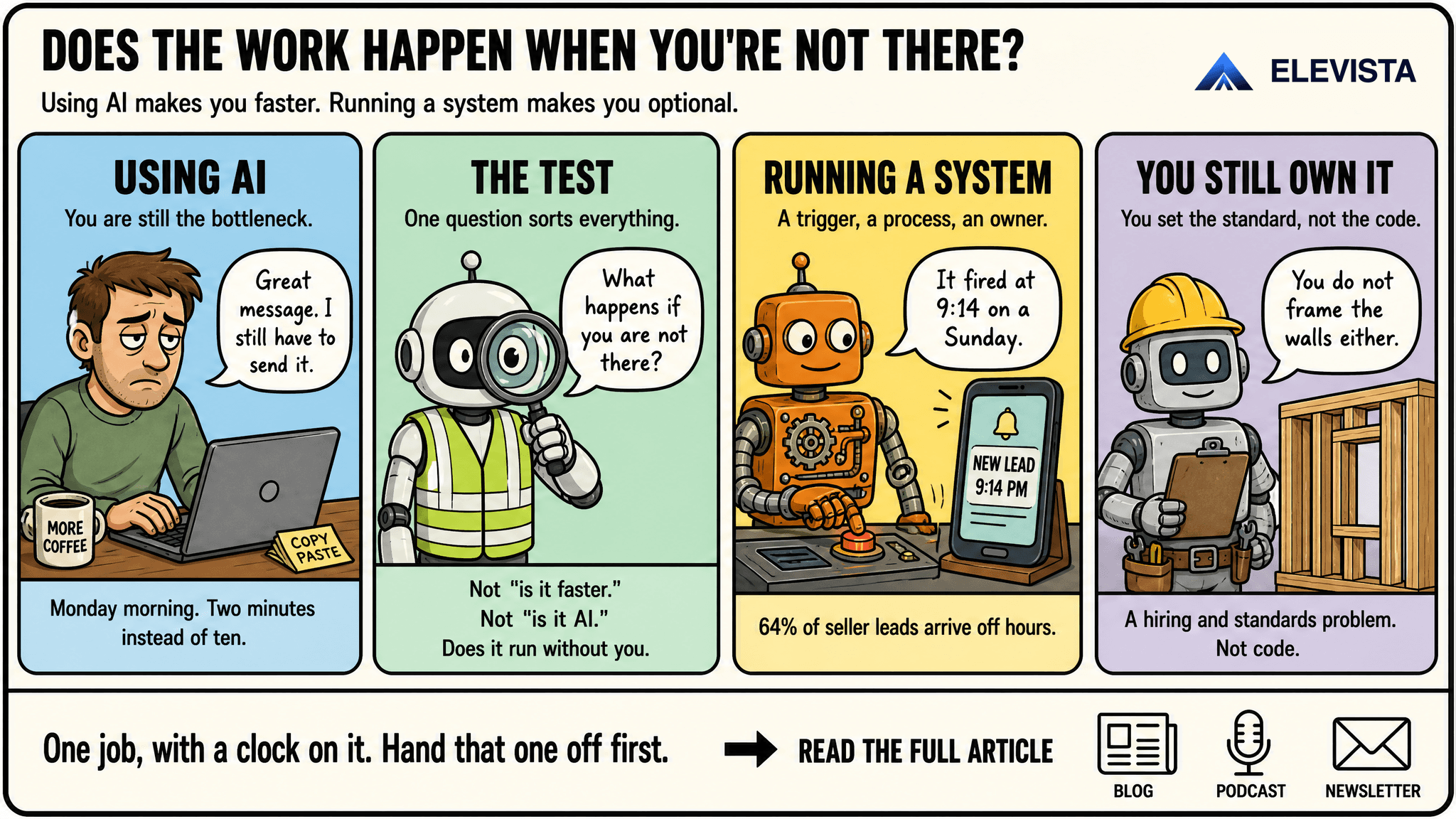
- Using AI makes you faster at a task you still have to perform. You're still the bottleneck.
- Owning a system means the work happens on a trigger, whether you're awake or not.
- The flipper version of "building" is not writing code. It's owning a process someone else engineered.
- 64% of our motivated seller leads at Clark St Homes come in off hours, evenings, weekends and holidays, so the first response is the obvious place to start.
The difference between "using" AI and running a system is who has to be present. When you use AI, you open a chat window, you ask a question or make a request, you get an answer and then you go do something with it. The work still waits on you.
When you run a system, something happens in your business, a process fires and the work gets done at 6pm on a Sunday while you're at dinner with your family. Same AI underneath. Completely different actions and a much different result.
The advice that doesn't fit a flipper
I laid out the three levels of AI use in the maturity model, hobbyist up to operator. This article is the single test that tells you where you're at on your journey and what to do about it if you want to grow.
Every hype thread about getting serious with AI ends the same way. Learn the stack. Understand APIs. Learn how data moves. Build agents.
That advice is written by engineers for people who want to become engineers. It also comes from self-proclaimed AI gurus who don't know a thing about how to find a deal or flip a house.
You bought a house last month. You're managing a contractor who's three days behind on drywall. You're not going to learn an API between a walkthrough and a closing. You shouldn't have to.
I've done over 75 flips. I don't paint. I don't install windows. I don't run wire. I don't frame new walls. I know what good framing looks like, I know what it should cost and I know when to fire the guy doing it badly. That's the job.
Software is the same. You don't have to build it. You have to own the outcome and maintain the standard.
The only test that matters
Here's the question that sorts everything: What happens to the work if I'm not there?
Not "is it faster." Not "is it AI." Does it happen when you're at a closing, at your daughter's game or when you're asleep.
A motivated seller finds you at 9:14 on a Sunday night. She's been putting this off for a month. Her brother finally told her to just call somebody. She fills out the form on your site.
At Clark St Homes, 64% of our motivated seller leads arrive off hours. Evenings and overnight, weekends and holidays. That's not a slow trickle at the edges. That's most of our leads, and they're landing when no one is in the office to catch them.
And she didn't only fill out your form. In my experience she filled out at least two more forms on competitors' sites, because that's what people do when they're stressed and finally ready to solve their problem.
Whoever gets to her first gets the conversation. They set the tone of the conversation. They begin to build credibility and trust first. They're the one every other investor gets compared to.
What using AI actually looks like in your week
You have ChatGPT writing your seller follow-up text now. It's good. Better than what you were sending.
Monday morning you open your CRM. You see the Sunday lead. You paste in the details, you get the message, you tweak it, you copy it and you send it. Two minutes instead of ten.
Then Tuesday you do it again. And Wednesday.
You got faster at a task you're still personally performing. That's a better shovel. It's not a machine. And it did nothing at all for you at 9:14 on Sunday night, which is the exact moment the deal was decided.
What running a system actually looks like
Three pieces. None of them require you to write code.
A trigger. Something happens that starts the process without a human noticing it. A form gets submitted or a call comes in.
A defined process. You wrote down what happens next, in order, the way you'd want it done if you were doing it yourself. Call within a minute. Follow up with a text and email thread, if you don't reach her by phone. If you do reach her, ask these four questions. Book the appointment if she's motivated (does she value speed to close over maxing out price?). Send it to nurture if she's not ready, yet. Text me immediately if she says the word foreclosure, probate or lien.
An owner. That's you. You define what good is. You look at what it produced this week and you change it when it's wrong. Somebody else does the engineering.
That last part is where most investors get stuck. They hear "run a system" and think they've been handed a coding project. Look at this like an employee, not code.
Nope. You've been handed a hiring and standards problem, which you already know how to do.
How to find your first one
Take twenty minutes this week and make two columns.
Column one: what repeats every single week in this business. Follow-up on new leads. Contractor check-ins. Comps. Buyer blasts. Draw requests.
Column two: what stops cold when you're not there.
The item that shows up in both columns, has a clock on it and is closest to your revenue is your first system. Not the most interesting one. The one where being late costs you money.
In my business, that was lead conversion. For almost every flipper I talk to, it's the same item: the first response to a new seller lead. It repeats, it dies without you and it has a clock on it that runs all night. Leads get stale fast.
The job is answering inbound seller leads within 60 seconds, understanding their motivation and booking the ones who are ready. Whether you use our solution or something else, pick the job closest to your revenue with a clock on it and tackle it first.
Do this
Run the two-column audit before Friday. One item, in both columns, with a clock on it. That's your starting point.
If you want help, schedule a free lead leak audit and I'll help you. It takes about 20 minutes.
Get insights delivered weekly
Join real estate investors who get speed-to-lead strategies and product updates every week.